web analytics

Category: season

  • hollowed pride

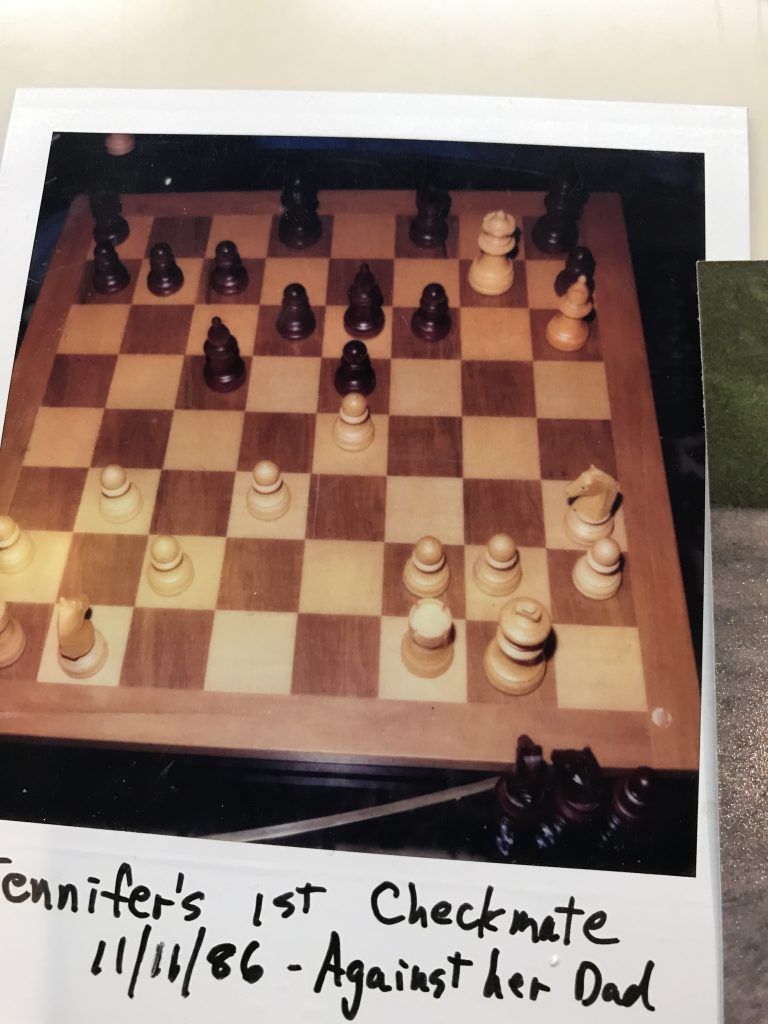
    The above image chronicles the last time I played chess with my dad. I was almost 9 the day that I beat him. He snapped a polaroid, bragged about it to others, and never played with me again. Eventually I found other people to play with, one friend who was a boy, and mostly boys in my high school chess club who were seriously tournament-playing with a timer during lunch hours and more interested in having me as an audience member etc. than letting me play. I didn’t really pursue it much after that as my attention turned to other things. What’s funny is that my grandad, my dad’s father, taught my grandma to play. And she beat him the first time she played him. He actually threw chess pieces around the room and never played with her again. She took up Mah Jongg with her friends and won almost every game. In her assisted living home where she went to live after my grandad passed away, they had games of skill and chance, and she won both unapologetically almost every time.

    But back to my dad, he was a tricky father to grow up with, and it’s almost funny to look back on some of my times with him now. He would confide in me about his problems with my mother, and tell me when he thought she was being unreasonable with me. My mom liked to describe him as having a touch of Asperger’s and to this day, almost two decades after their divorce, won’t concede that he was also narcissistic.

    We did some great things. We went on one scuba vacation when I was 17 or so, and my dad was upset to learn that I used less oxygen than he did. We were dive buddies and at one point under water, he came close to running out of air. He swam up to me, with a panicked look at one point. I suddenly realized with clarity that if he were to run out of air, he wouldn’t think twice about taking mine. We ascended to the surface, but the realization shook me for awhile after that.

    As I grew and had opportunities, he wanted to join in them. 8th grade math club – he became a parent club leader because he wanted to do the math problem sets. Though I was supposed to grow up to be a chemist, physicist, or doctor. No other professions were considered valid. Asian Civilization class in high school: he took my books from the class, then took himself to China. He has not yet returned my books. He also took my books from Spanish class, and then had an affair with a woman from Latin America the summer after I graduated college. “Jen, this family is broken. I’m having an affair with a Sandinista from the coffee shop at work who has an AK-47. Should I tell your mom? What should I do?” When I took a sailing class, which I hated, he bought a Laser sail boat, took me out on the mountain lake that could have stiff winds without knowing how to sail himself, but wouldn’t let me steer. We capsized three times. A storm came up, and someone in a motorboat came out to rescue us, which was humiliating for my dad. I was hypothermic by the time we were rescued and had to have a rescue blanket.

    One night, after I’d found my girlfriend in Portland, I talked on the phone with him after he’d had something to drink. “I have to go eat dinner” I said. “Don’t eat the pussy,” he said smarmily. “It’s really gross.” He hates cats.

    Every weekend when I was in high school, we would go together as a family to the mountains on my dad’s prerogative. There was no way to opt out. We had to be ready to go by the time he got home from work on Friday night or he would throw a fit. I missed all the high school parties, never even tried weed till I was halfway through college. Because I was coming to terms with my lesbianism, I didn’t totally mind missing all the high school social events, but I think I could have used more of a social life. At that point nobody was out in high school. By the time my sister reached that age they were more relaxed, letting her bring friends up or spend the weekend with friends instead. Perhaps they worried that I was gay because I hadn’t been allowed to have more of a social life and wanted to make sure my sister wasn’t so locked down. Summer camp was incredibly transformative because it allowed me to have a time and place to develop friendships and forge a connection to the mountains on my own terms, without my dad controlling and mediating the experience, or the forced march of the hikes he chose. When I would challenge him, my mom would implore me to stop being difficult and stubborn.

    When I was a senior in college and came back for vacations, I realized that I’d emotionally outgrown both of my parents, which is a bit of a shattering realization to have. They told me they thought that what I called empowerment indicated only that I’d been brainwashed at my women’s college. My mom still hopes that I’ll realize I’m straight. But the transformation of that last magical last college year, when everything seemed to coalesce and integrate and I found the start of an academic stride and belief in my abilities stayed with me to a point as a new way forward through life, even if it has at times come into question, or something I see now as more of an idealized vision than of something which can correspond with external reality in all ways I’d hoped, and the double-edged fortune of being able to grow into such a supportive environment – so difficult at times to re-create or to validate in retrospect.

    My dad and I still occasionally try to have a relationship, but then it all flies south. It usually starts with my dad showing up with a grand financial gesture and an idealized vision. A trip to Europe, where I will do all the interpreting. A bike trip to ride the French Alps. A ski day where he can be proud that I ski like he does. When I turned 40, it was a mountain bike trip – though it had to be one he chose. We went to Moab for a 4-day bike of the White Rim. I was a strong rider and could stay at the front of our group. My dad, who had become deeply interested in geology (a room in his basement is now filled with rocks and he has three different geology microscopes), took his time to look at rocks and stayed close to the back of the group. On the penultimate day of this 4-day ride, he exploded. “You little bitch,” he confronted me on the rim of the canyon. “Can’t you see my hip hurts? I’m at the back of the group. Selfish ingrate. You haven’t biked with me enough. This is our last trip together. I don’t ever want to see you again. And you’ve gained weight. You’re my biggest disappointment.” I calmly told him that I believed that he had been looking at rocks and had been happy taking his time, and that everyone is only competing against him or herself. “Shut up.” he said, suddenly afraid that the other group members would hear. We ended the trip, and he didn’t talk to me at all during the whole 6-hour car ride back to Colorado. “Have a nice life.” he said as he dropped me at my mom’s house.

    Over time I’ve come to understand now that he has very limited emotional bandwidth and not much room to operate outside of picking up his marbles and leaving the playing field when he doesn’t win, but that doesn’t mean it doesn’t hurt every time. On the other hand, my dad never had many others standing up to him or stayed in situations where he was confronted. I was someone he couldn’t escape who did stand up to him, and one time he told me that he thinks I’m one of the strongest people he knows. But there was always a price for it. I’m definitely the black sheep of my family.

    I think that my experiences with my dad compelled me to try to find a different way, also set me up to understand that sometimes success comes with hidden costs and agendas, that sometimes gifts are for the giver, that some battles are more worth fighting that others.

    What threw me was thinking I had found something different in my ideals about academia, which felt oddly familiar though I couldn’t explain why to myself at first, only to realize that no, others do not always support or welcome or honor one’s success, and actually this sort of blindsided me because I thought I’d had better judgment than to let myself in for more of that sort of pain. At first I didn’t understand why some of the older grad students seemed to make a point to keep their heads down, to underperform. I thought it was sloth, or maintaining a status quo. I didn’t fully appreciate that it was a sort of compromise for survival, and that, being idealistic, I was not somebody who could live well or non-self-destructively with making the sorts of compromises one often has to if one wants to survive where there are hard edges of people at play. The shame, fear and anger of tolerating unfairness or abuse could eat me alive. Which sort of leaves one floating in a no-woman’s land of not knowing anymore what is safe or who to trust, and unwilling to throw more effort at it.

    It’s always been easy to try not to be narcissistic or repeat those patterns, but it’s been hard to unchain that from also not having success. Like if one has success without power one gets squashed, but success with power makes people narcissistic through some mysterious alchemical process. Which I know is false, and certainly there are enough examples around of successful people who don’t need to take others down, but somehow it’s still hard to believe.
  • Freeze / Melt

    The ice storm of a week and a half ago turned out to be the most destructive weather event here in the last 30 years. I didn’t ever really have a moment where I felt endangered, but going through the motions of survival was probably good earthquake preparation. Being disconnected from the internet was a useful jolt reminding me how the wired world had gotten into my veins. It was a great time to catch up on reading, and to let the circadian rhythms reset as all the windows in the buildings were truly dark at night and the low-level buzz of electronics, air purifiers, etc. absent. We weren’t out of power so long that the novelty and fun of solution-finding and adaptation wore off before it returned.

    I had nightmares, mostly about being abandoned. In one very visceral and vivid one, I was wordlessly left alone at the parking lot of a movie theater and had to swim against a current of people to reach the ticket desk to buy a ticket I didn’t have/didn’t know where to get. I didn’t know anyone there. Except for the ticket-seller/taker, the receptionist at the first language school I had taught at in Berlin. I didn’t even know what was playing, just that it was par for the course that I would drive my car to the theater and attend. It was a sunny afternoon, somewhere in suburbia in the U.S. The person who had been a passenger in the car I drove got out as soon as I parked and I could not find and never saw her again. When I woke up the sun rose and life went on, but the emotions from that dream continued to swirl.

    After the world became again “vom Eise befreit” and things like hot showers, machine reboots, a tank of gas were taken care of, the hard part started. It was very difficult for me to switch gears out of survival mode, like the gear was jammed, stuck. The world wasn’t appreciably less safe, we still had a shiny new president, a generally working infrastructure, I still had work, housing, warm meals, company. But I still found myself feeling jarred, jangled, anxious, empty, at loose ends.

    It was like when all that ice melted off it left me with raw nerves that no longer knew what to do. Even though the freeze itself wasn’t really terrifying at all.

    Since then I’ve been swamped with more old junk that I thought I’d cleared out, but apparently not.

    I started thinking about how past journeys or endeavors I’d taken on had later been revealed to have been based on living in what turned out to be false realities or false sense of safety, or foundations that were more air than ground, and how reluctant I’ve been to undertake big things given the new awareness of the likelihood that I would not be allowed to return, not allowed to find my way back, that “home” would evaporate and not recognize me upon my return, or that the safety is an illusion. The sensation is sort of a sea-sickness from behind, like a moment you realize that there’s no water in the swimming pool you’ve jumped into, or a dream when you are flying and only mid-flight realize that you don’t actually have wings and thus drop out of the sky.

    Feeling still that the emotions were out of proportion to my life, I’ve also started looking at where this may be rooted in things I can see and those I can’t, even ancestrally. I’ve been thinking a lot about my great-grandmother, whose home town became occupied (or restored to its owners, depending upon how one looks at it) and city renamed after she left Ostprussia. I wonder if she felt anything similar in terms of the impossibility of a return. She did return to the area a few times to visit relatives who had become scattered around the vicinity, but she couldn’t return to the place she grew up. I’m talking about something different but similar to not being able to set foot in the same river twice, something a little more viscerally aching. It’s also not the space time passes through in Agamben’s bee. Maybe it’s more about being outside of a time which has passed, outside of inhabiting the home of oneself, or a stuckness like a foot trapped under a boulder. Hmm. I can’t quite define it right now, but it’s fairly terrifying.

    During one Christmas I spent in Germany, 2004 I think, my relatives who live in Hamburg, with whom I’d just a few months prior gotten into contact with upon moving to Germany again, invited me to spend the holiday with them. Being stationed somewhere for a year or two can make new friends hesitant to want to develop any deeper bonds, so it was exciting to connect with them. It’s fine to not know anyone and be free and edgy for awhile, but after the novelty wears off one searches for more sustainability.

    On the front edge of that experience had been another, one of those moments that you’re not entirely sure you imagined or not. A collision when I was out one day, but the person I collided with caught me from falling over with a hand on my upper ribs, just grazing my breast. I was reflexively caught off-guard, but not offended. It was an edge of something where I knew that if it were unleashed, I was not yet strong enough to be able to emerge intact on the other end of any crash, that failure would destroy me, that all of my plans would go out the window, that gravity would take over and my life would become one big mess, and I could get hurt or someone else could. It seemed a lot smarter to stay free and have some bier and to just skate on the surface, to hold onto what little sense of power I had. But that surprise steadying handprint followed by its absence was seared into my side, and I didn’t think about any repercussions for a long while. But maybe it wasn’t really a space for thinking.

    What did know was that I hoped, hoped, hoped that that encounter sprung from somewhere authentic. I had had an advisor who kept close tabs on me via others who had kept trying to force people into my life in sensitive areas in ways which were really uncomfortable and unwanted, sharing with them information that I hadn’t given her, leaving me out of discussions or decision-making about my own career, coopting my efforts, even personally attacking me. She was not able to show up for me in terms of advising, responding to me in class discussion (or even allowing me to speak) or returning work, but seemed to need to send others as proxies into a space I had not ever invited her into to poke around. She also tried (her position gave her the legitimacy to do this) to take control of and force my career, my narrative, to force who I could work with, to basically disempower and disenfranchise me from being able to follow the paths of my own interests and inquiry. To obstruct me from all that I set out to accomplish. Never a single word of encouragement. Infantilizing and also then very difficult to climb out from under as I was always on guard and always had to question who was doing what with my career and why, and to be on guard for the personal attacks she launched. For this reason it took me the better part of 2 years to begin to trust someone who was wonderful in many ways but with whom I did not feel an intellectual chemistry, who this advisor had forced me to change plans to build into a student conference, in a place that the advisor had changed the rules I’d played by fairly to force me to study. I really got slammed around, and I didn’t know why or who had initiated it, if she was a proxy for someone else, or acting out of her own place. More than once I wanted to scream at her that the people in the program were not her marionettes. But if I told the person the advisor had forced me to study with about my discomfort with my advisor, I risked retaliation.

    My Hamburg relatives extended great hospitality and took me to Cuxhaven, where first my great Opa and then later my great Oma had sailed off from. We walked along the beach for a long while. There’s a point called Alte Liebe and restaurants which look out on the beach and serve baked fish and Gluhwein. My great Opa had never attempted a return, but in the 1930s my Oma and my Grandad, then 13, had arrived for a visit and then departed again. Visiting that point of departure/arrival/departure into the future which had created me was an odd and interesting sensation. My relatives also brought me to Lubeck to visit the Thomas Mann house and the Niederegger Marzipan museum. My distant cousin, who is just my age, gave me a wonderful tour of Hamburg (including the Reeperbahn of course) and a copy of Buddenbrooks for Christmas, and my Aunt once or twice removed had knitted me socks. When I left, we traded scarves and hats to remember each other by, and still write letters. Lucky me to find that port of call.

  • Interregnum

    Interregnum

    Autumn is usually when a deeper, bereft sadness and sense of uncertainty and out-of-jointness has tended to surface, it’s just the time of year when hard or stressful things have tended to accumulate over the years and leave a heavy residue. Usually I don’t get through it without buying a few school supplies (though I’ve been out of school for awhile) and sneaking out a few times to smoke Djarum clove cigarettes, with the first one always bringing me close to either fainting or throwing up, and these actions somehow helped with whatever felt wrong. When I first moved to Germany in the early 00’s, congregating with others who had or needed “Feuer” was a great way to meet people and socialize. So it served a great social survival purpose (I always carried two lighters just in case the my first didn’t work), as well as being a daily flirtation with my own mortality that helped me to feel I was walking the edge of being alive. These days, my origami kayak fills more of that role – inevitably people are drawn to watch as I unfold and construct it or refold it, and in this way I meet people in suburbia; I spend more time talking with people than actually setting up or taking down my boat.

    However, that deep bereft sadness, cloves and school supplies have not been a part of this autumn. Which is strange given some uncertainties around a planned but still pending separation from M. Perhaps it’s a more global sense of being alone together in the covid19 era which alleviates some of the past isolation, or the gentle rise of worth and utility in the shared purpose of political and global activism and interest, or maybe the sadness that afflicts so many has made mine just a small drop in the bucket. But it seems like more than that, something on a subconscious level that feels very primal that’s been popped back into joint as the larger world order becomes more restored, and something else released. Like I could finally digest some things and keep them down. Like being bent over a pain for a long time and then supported in standing up again without the weight and being entirely new in one’s opened body, a sensation approaching holding an active peace. Like I’m more me. Before this season, I had been feeling bad or defective that I had not been able to heal, control or regulate some things on my own, and that the help I had found along the way hadn’t in fact been terribly helpful.

    Healing can be a tricky thing in terms of figuring out the space in which it transpires and who is involved. Following the ankle injuries that landed me in the hospital, my dad decided to make a visit while I was in skilled nursing. He wanted to bring his new wife, who I did not know well, and with whom I had very few positive interactions or associations on file. I did not want to see her while I was feeling so vulnerable and lame, and I did not want her to be the one telling all of my extended family members about my medical status. It felt like an intrusion. I just didn’t really have the bandwidth to deal with newish stepparent dynamics on top of everything else. But I did want the support of my dad. So I told him it was fine if he brought her along for his own support and to do things with in the city, but I’d rather not have her visit my room. This made him incredibly angry, he felt insulted that I was not as accepting of his new wife as he wanted me to be, so he visited for 36 hours and was cruel and pouty the whole time. So my solution didn’t really work for anyone. I would like to believe that I would, if confronted with that situation again, have the grace to have them both visit or ask them to postpone until I felt less vulnerable, but at the time it was also important to honor the little sense of control I could have over my space and circumstances. On the other end of the spectrum, I had a wonderful local community of friends which I didn’t really know I had before – I’d met most within the year via a meetup group and the things that spun off of that – show up for me in wonderfully supportive ways. Many who visited me also brought their potions, lotions and notions about how to heal and how they could help. One friend sent me blue light through the matrix. Another brought crystals, and a third tinctures of homeopathic remedies that she wanted to talk with my doctor about. So some of it was an exercise in finding diplomatic ways to say thanks but no thanks while still appreciating and connecting around the intention. I have to credit the support of M and of my community as being a major factor in why I was able to recover well. Well ok, M is more social than I am and played a big role behind the scenes of reaching out to mutual friends behind the scenes on top of visiting each day, so she gets even a lot more credit than that.

    Emotional healing is a different but related thing. The first time I went though a deep emotional healing, it really took me by surprise. It happened very organically and it “just was.” They say that during your 20’s, you come to terms with your family and work on seeing and separating from it. I had been taking a class which dealt some with literature that featured family dynamics somewhat similar to my own. But I think the much bigger contribution came from feeling seen, appreciated and supported in my life in ways I never really had been before and hadn’t known I could be – it had been a field of fresh snow that I hadn’t even known was there for someone to cross, like it had been in my blind spot all my life. Though it took a little time to warm up and although it was incredibly frightening to feel so suddenly vulnerable, I was incredibly fortunate to land in what felt like a perfect fit of a situation which unloosed, at warp speed, a Great Unlocking on more levels than I could count or could process at the time or have fully processed. Someone had taken my arm and escorted me across a bridge into a new dimension of being. After something like that happens, one feels a deep well of gratitude and then, creeping in, also a new fear of losing and having to let go of what now seemed essential and the New Way Forward and a search for ways to perpetuate it, as well as search for the words to describe this new place. And then if one describes it to the wrong people using some of the terms and frameworks available to do so, it is actually quite striking how unfathomably bad and evil it can be made to sound. It’s the sort of thing that one just has to be there for, but also absolutely cannot be abandoned within. It’s hard to just rest in the deep quiet place with it, where a knowing just surfaces as though from a deep spring – but in not doing that, in the search for explanation of something which “just is,” one risks losing touch with the quiet deep place and the agonizing, snakebit and fallen from Eden task of trying to recover it, which only drives it further away. Like those finger-trapping toys – the more one struggles to get free, the more tightly it traps the fingers. Maybe the big gift of covid is the stillness that lets us look into the water again.