web analytics

Author: J

  • Landing in Calais

    Landing in Calais

    Sometimes a memory surfaces of an experience I had while backpacking through Europe, at age 19. I carried the same heavy Mountainsmith 65 liter backpack I’d used to climb Mt. Rainier and lead backpacking trips at a summer camp in the Colorado Rockies, and the same attitude of exploration and desire for new vistas, carrying all I needed in my snail shell of a pack. I eventually sold that pack and downsized my travel and backpacking kit, in an effort to travel more gently to myself in the world. Discovering more gentleness within and for myself has finally brought more ability to take compassionate care of myself while traversing challenging memories, and to honor my own story.


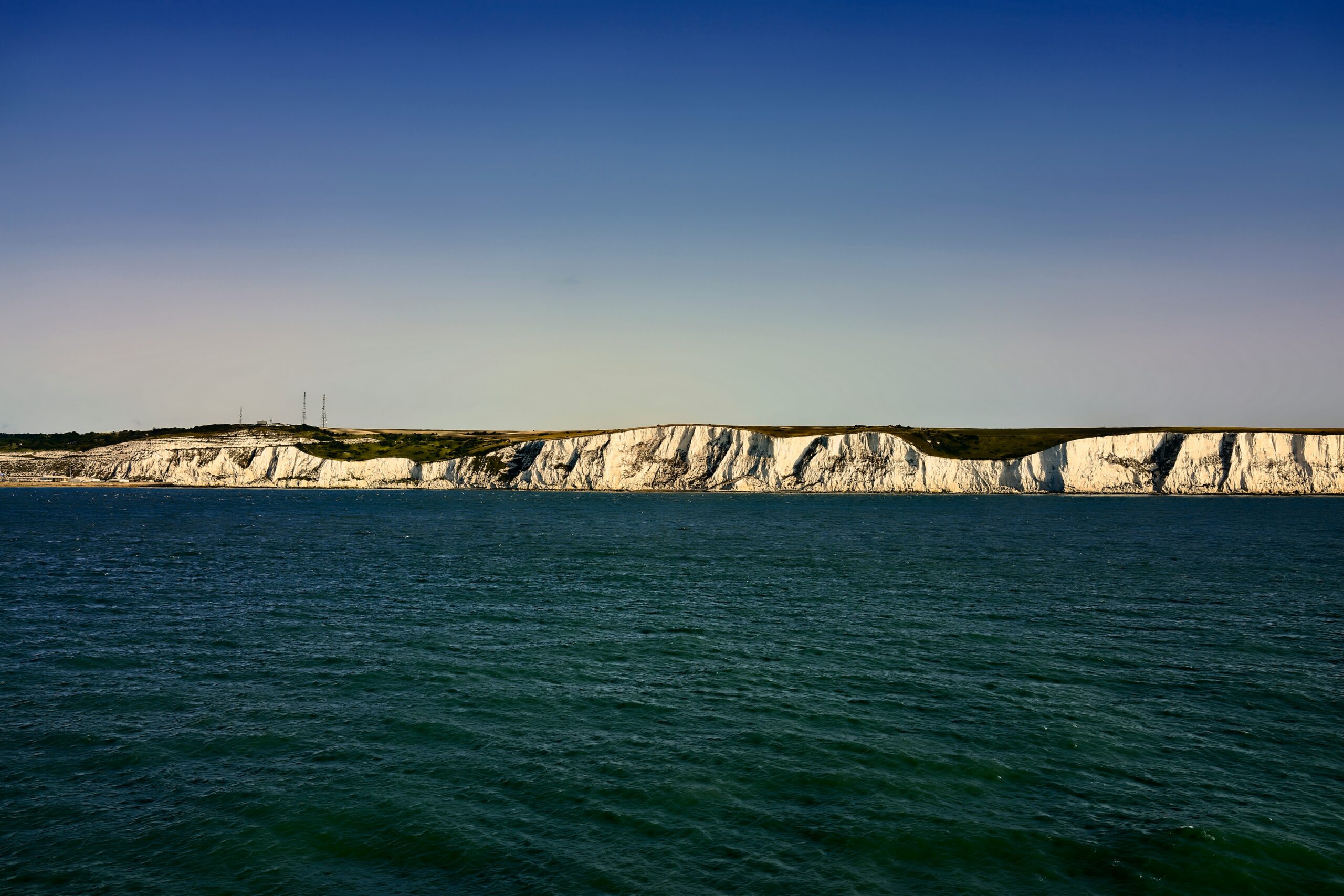
    Early in my journey, I took a ferry from the beautiful White Cliffs of Dover to France, landing in Calais. As the boat prepared to empty, I needed to use the restroom. So I found my way through the white decking, there were a couple people lined up for the single stall room ahead of me. I waited my turn, increasingly anxious in the flow of disembarking passengers that I would get stuck on the boat. Soon before I was up, a group of drunk French women in garish makeup arrived, 3 or 4 of them. They were still having their party. When it was my turn to pee, one of them grabbed the door and tried to get in ahead of me, but I was faster. They began to yell at me in French. I had put my pack down and was about to sit on the toilet, with my pants halfway down, when one of them somehow yanked the door open. Then two of them grabbed my arms and tried to pull me out of the bathroom, but my pack was in the way. I managed to protestingly push them off, get the door closed again and finish my business, as they yelled at and mocked me as I exited. By then, there was nobody else left on the boat but me, the women, and the crew. I tried to mention the incident to the impatient crew member at the exit before walking the long ramp to shore, but he just shrugged. I went on my way, shaken, to try to find my way to my meal and lodging as fast as I could.

    It was an upsetting, humiliating moment. I was trying to take care of a basic human need, had waited my turn, and so cruelly had my privacy violated by that chaotic gang in such an ugly way. I felt very alone in the world, and that I had no recourse but to try at all costs to avoid groups like that. I took the Chunnel on my return trip to study abroad for a semester in London. 

    That travel and subsequent semester living abroad was filled nonstop with startling and surprising encounters, both enchanting and discomfiting. By the time I got back after having been on the go for so long, juggling the constant concerns of finding hostels, food, getting to what I wanted to visit, navigating different cultures, keeping track of everything, my nervous system had become pretty wound up. It took some months to process all of the different experiences and the chaos of the world at large.


    In the warmly lit classroom of my small liberal arts college a month or so into the fall of my senior year, I found myself feeling like I was just in the right place at the right time, somewhere I wanted to stay forever. The class on feminist literature and film took place two evenings per week with an additional film screening. I had slipped into feeling deeply co-regulated with my brilliant butch professor. My ideas became effusively lofted and my experiences gained context in the scope of world and literary history as I was encouraged to “unpack your ideas” and “externalize more.” Not only that, I was suddenly getting needs I hadn’t even realized I had had met. Needs for approval, support, encouragement to go to grad school, having my sexual identity validated as she regularly participated in the lgbtq club I helped lead one evening per week, being told I was smart, having my skills recognized, having someone outline a future pathway where she believed I could be successful.

    Someone who not only fawned over but also confided in me, and even needed my supportive presence. Not only that: feeling that someone found my body attractive, was flirting with me: I experienced myself for the first time as a full woman who was being desired in a way that I found that I really wanted to be desired. It was so natural to flirt back, I surprised myself with the new part of me which had been unleashed. I was being taken seriously as a scholar, and as a woman. I felt cherished and tuned into, at every level. 

    She was often one for dramatic gestures. When I accidentally dropped a piece of paper during a film screening introduction, she would leave the podium in the middle of her talk to swoop up the aisle to pick it up with a flourish and return it to me. “Yes, my dear,” she would say when I raised my hand in class. My friends in the class teased me about it. After a lgbtq meeting on safe sex where we embarrassingly discussed dental dams (we were the generation raised in the shadow of the AIDS crisis), she made sure to pull me aside to inform me that nobody really used them. In the next class alongside a literary mention of syphilis, she said: “The safest sex, of course, is masturbation!” as she looked at me. 

    We effortlessly seemed to read one another. I absorbed all of this like a sponge and took it deeply into my being. My confidence in my intellect and in general soared. I felt so much gratitude and awe. Awe for the sense of understanding that bound us together. So natural. It began to feel like an instinctive, primal bond necessary for survival. I felt embraced for all that I was and could be, and needed for my unique being and understanding. A vast new connective space of shared power had been revealed to me and I felt seen and cared about, as we mirrored each other in the midst of discussing psychoanalytic theory and women’s narrative literature, and as she took part in club events I sometimes ran. During office hours she would winkingly recommend I read the books The Bonds of Love by Jessia Benjamin, and The Practice of Love, which was on film theory. It seemed we could even control time and space. I took that limerant waltz.

    We were a united front against the world, and against whatever sufferings and inconveniences she was facing from the college administration which she had deemed incompetent, annoying colleagues of hers, the persecuting enemies of hers in her field, or her allegedly depressed or deranged exes. Being confided in at this level felt so familiar, as my dad had often confided in me his dissatisfactions with my mom, his colleagues and extended family. But WE were allied in our joy in the true causes of feminist lesbian liberation, literature, and the world of ideas.

    On that island of perceived safety, I also began to realize and mourn things about my family. I went through a deep grief about the love and validation I had missed out on from parents who, in spite of their love and good intentions, had their own limitations and could not fully provide what I had needed. Bittersweet because of my current state of happiness and increasing fulfillment in feeling so fully met. I didn’t really even have the words for it at the time. The birth of a new soulfulness.

    It was a seismic shift, and directly impacted my ideas about myself, my potential, the worlds I could belong to. I became dissatisfied with some things about myself that I wanted to improve and grew like a weed, intellectually, personally, and even spiritually with new ambition and confidence. 

    At one point, after an evening lgbtq club meeting, as we were exiting the building she said “my car’s down there,” and we fell into step walking together right towards it, but at the last moment, I turned off for the library. I had had more casual, experimental sex with other students – but this was different, and I didn’t feel ready for it. In class the next day, she remarked: “There are the women you sleep with, and then there are the women you marry,” looking meaningfully at me.   

    I began to feel more isolated, separated from my peer group by my ecstatic, almost febrile experience of a special shared connection that I instinctively knew not to tell anyone about, but that separation seemed to matter less when I believed that I had been so deeply received and understood; maybe I had something better.

    Because of my blossoming intellectual interest combined with renewed interest in my heritage, I had signed up for her second course in the spring semester, but this unfolded differently. She seemed almost disappointed that I was there, even possibly bored with me. She became more distant, calling on me less often in class though she still attended lgbtq club meetings and flirted with me outside of class. This was accompanied by an increasing, frightening vulnerability as I continued to seek her admiration but was not quite sure where I stood. “I really trust you” I had told her one day, wanting to convey the vulnerability I was feeling, which was now in her hands. “Thanks, that’s really sweet,” she said. Once or twice she made some cynical remark that cut me, but then quickly said “just kidding.” I worked even harder on the class material and did wonderfully in all my other classes and my senior thesis on Virginia Woolf’s Orlando in a different department. I was still inspired, but unsettled.

    I felt academically like I had really found my footing, but also like there was so much more to learn, like I was just beginning to grow at the bottom of a big trellis in that new field, and that I needed and wanted to stand on my own feet in order to be able to stand even better in the space of whatever relationship it was. To feel less dependent. This led me to bury some academic needs beyond the class minimum in order to perpetuate my new exciting status of being treated more as a peer or romance than a student as it became clear that maybe I couldn’t have both. No, I did not want a demotion, I liked being relied on by someone I so admired, it made me feel special, and I wanted to show I was sophisticated. She had encouraged me to go to grad school; maybe that would be enough, and I could take care of the footwork to make it happen on my own. So some of my student needs for guidance or budding intellectual interests went underground, because she was surprisingly not seeming into those anymore. I sensed that in acknowledging or putting them forward, it would be too much, now that managing the relationship was my job, too, and she seemed to be bored with the academic part of things. If I brought them forward, I might have to sacrifice the very fulcrum of my growth and new state of being; it would disrupt our shared intersubjective reality that superseded and tunneled through any power constructs (as the Bonds of Love described them)– trappings that my academic needs would reinvoke. I felt like maybe I’d done something wrong by enrolling in the second course. But she invited me to lectures by visiting professors in the field and introduced me to her colleagues almost as a peer, and complimented me on the alumni panel I’d organized for the lgbtq club.

    I had learned to sit with the uncertainty, my lack of control of the situation but welter of feelings, and trust that over time, I would find out, and that she knew what she was doing and ultimately had some sort of control or plan. I wondered if maybe I just wasn’t naughty enough and found solace in the ritual of smoking; she smoked and it was quite a dramatic action for me to take as an avid outdoorswoman and athlete. It had troubled me that she smoked, and I wondered if I could start and quit, and then she would of course quit, too. I could rescue her. 

    After the semester ended, she greeted me warmly and asked me pointedly if I intended to stay in the area. We shared a long meaningful hug that might have gone further had I not needed to request a recommendation letter that compelled me to behave more formally. She remarked that my visit was like a breath of fresh air, and that she didn’t know what she’d do without me. All of that magically wiped out any uncertainty about where I stood that had accrued the prior spring. 

    And yet, I wondered, if anything were realized, could I really support her full emotional weight which would surely land on my shoulders, and did I want to be tied down on the brink of possible independent adventures in the world? I didn’t even know how to cook. Would I get to have a big meaningful career, too? What would it be like to sleep together? Would I be able to stand my ground if we fought? I wasn’t so sure. Would she like to hike? Could I be happy living more permanently somewhere without mountains? Would it even work? What did I really want? Did she want kids? Did I? I had never had a relationship, and I was intimidated by the thought and by my own inexperience. I mentioned that I had a summer job lined up and wanted to give some thought to my next steps. Even as there was still a lot of confusion and ambiguity surrounding that experience, like: Why me? What was really happening? What had really happened? What control did I have over it? How could I affect it? Did I cause it in some way? Was it ok? Where did I really stand? What did she really want? What were my options? What could be acknowledged? What could the future hold? No answers that I could discern by not asking. 

    The summer after I graduated college, after I finished my summer job, still aglow from the prior year, my family suddenly fell apart. If I’m honest, at that time I probably wanted someplace soft to fall and all the tenderness in the world, to be somewhere stabilizing when that happened, but didn’t know how to ask for it. It pushed me to a tipping point as my system went into overdrive to escape that overwhelming situation where both distressed parents were pulling me in different directions but I had no actual control over how anything unfolded, I helped my younger sister get stabilized and pack up to return to college in Maine for her next semester, and took the GRE exams. In the midst of that crisis, I wrote her a love letter. In some ways, it was also a crie de cour as I saw the foundations of what I had grown up understanding to be love demolished before my eyes and I wanted to stake myself to my own new experience. She eventually, a couple weeks later, impersonally responded that she could not get involved, and could not take responsibility for my feelings, and did not want to talk on the telephone. But of course,  I reasoned, what else could she really say in writing given that she was just coming up for tenure, despite all she’d said implicitly about it and all the many indications she’d given me that she was as attracted as I was and cared about me romantically. The last thing I wanted to do was jeopardize her career, our possible future in any way, so I didn’t ask my questions. I reconnected with a couple of old friends I hadn’t seen for awhile for support around my questioning dejection and also my family.

    By the autumn I’d moved to Europe to teach English, where I stayed very busy navigating employment and visa situations, learning all I could (language, culture, literature), and, after a year, applying to grad school. Nonetheless, the sonorant, gentle voice that had encouraged and flattered me the prior year had moved into my mind and heart, her words a presence that urged me on and buoyed me into the following couple of years even after I had “left.” One foot stayed bound to that time as the root I would grow from and thought I could reunite with after more time abroad gaining life experience and learning. 

    In the throes of trying to survive, I didn’t have much time to pine away – but the idea that she was just across the ocean and believed in me, that my work was in service to shared goals, and that we could reunite in some form later, even if only professionally, provided a sense of comfort and security in the hardest moments. Step after step, I found my way, holding my precious red thread.

    We stayed in friendly touch via email over the next year and a half, as she had encouraged. I shared pieces of my life abroad and congratulated her when she shared that she had gotten tenure. I also ran my grad school acceptance options by her, partially because I wanted her to feel like she was looped into the decision, and secondly because I didn’t know who else to ask, who would know both me and the field. We had a brief phone call about it, where she confusingly said: “The more the merrier, huh? Just kidding, I think you’ll do well.” So I thought that she was on board with my choice, having had the opportunity to warn me of anything not in my – or our – best interests. She responded with a little more information about the strengths of each program, and that she didn’t think I could make a wrong decision.   

    So I visited three on the west coast, eventually landing in X (where she was an apparently disengaged alum of 10 years and had in my senior year once said she could really see me at) with a fellowship. I thought I could do well and even find answers to my lingering questions unobtrusively across the country from her, in a place that would still give me some intellectual familiarity and what I needed to stand better on my own feet, to grow into the peer role that I’d been assigned but that had felt too big for me before. To not just be treated like a peer, but to actually become one. To be able to play well together in the world of ideas and eventually maybe more – perhaps even over the course of a lifetime – as I could bring all my new knowledge to bear. One long beautiful conversation. Starting grad school was a tender space of development, because I now needed to take risks with my ideas that until then I’d only been able to work with in isolation while living abroad on my own for a couple of years, without any forum for discussion. I needed to keep building the voice I had begun to develop. To professionalize. I was on my path.

    All of these seemed basic needs in understanding myself and where I belonged in the world, and in growing into whatever potential I had. I paid attention to whatever meaning and glimmers of answers I could get from the literature and amid the new caste system of characters. I put my full being into the effort as my work became central.

    At the same time, I wanted to show her that I had brought something back, and that I was on my way: assemble the shards I had collected over the few years into a great big mirror for her that showed that beyond the mirror I had re-created for her, there was me with my gratitude, collegiality, respect and care, in our familiar shared language. If I could somehow inhabit the mental, emotional and physical space of being there, where she was and wasn’t, perhaps I could understand what had happened too, and heal or meet my own needs and open questions. I strove to be the best student.


    Everything started off wonderfully. I was thrilled to be back in an academic setting and did well in my classes, got along with my fellow grad students, and even secured another fellowship for the summer so I wouldn’t need to start teaching until the following year. Mount Rainier gleamed on the horizon on clear days, a touchstone of achievement that anchored me to my ambition. 

    Our emails had trailed off, but then the department head announced that my professor had volunteered to organize a big alumni conference in my program which would be preceded by a grad student conference the day before. I was curious and felt both reassured that I’d get to reconnect with her in a professional setting, and some pressure to perform, because I wanted her to be proud of me. 

    I didn’t know what happened when one day in the spring of my first year she walked into my shared windowless grad student office, which was bathed in headache-inducing fluorescent light, took my officemate (another student from my same undergrad institution) to coffee, and stonewalled me. Like she didn’t even recognize me. I felt suddenly, shockingly intruded on in my new professional space. 

    The blinding gut punch and sense of impending doom from her cold visitation sent me into the arms of first a colleague with whom I’d become friends, then the university counseling center. When I finally emailed her a week later to ask what was wrong, she had the undergrad college psychiatrist on the other side of the country call me as a proxy unexpectedly at home on a weekend as I was working on my conference paper two weeks before the big conference. The psychiatrist communicated that the professor had “moved on” and that my questions were “inappropriate” and that I was not to attend the professor’s panel at the upcoming conference. What? Moved on from what, and to where? Had I done something wrong? I was simply unable to believe that someone who I’d been led to understand would be in solidarity with my efforts the way that I was with hers, actually wasn’t. It must be a trick, she must be doing this for my own eventual benefit, but what was it? Was she trying to hide us for some reason because she didn’t want me to get hurt, and did she plan to make it up to me later? Was there some big misunderstanding? I thought I was safe? I thought I was landing and could again unpack my experiences and ideas? What the hell was going on? I had the psychiatrist talk to my therapist at the time, then I heard the words “bad boundaries,” “we agree the problems are on the other side,” and “it’s like you two are holding a bomb.” What? My steps in my new program became more uncertain, and I wasn’t even officially out of the closet yet there beyond a handful of fellow grad students, I didn’t see it as relevant to my work.

    I was unable to believe that I had simply been abandoned, that the ground had been swept out from under me. I was unable to believe my new well-meaning professors who gently let me know that she’d been saying negative things to them about me and had outed me. I thought that they had something against her, did not like my allegiance, and wanted to drive a wedge between us. “It’s not your problem, but it’s your problem to deal with. You may want a lawyer,” one senior prof frighteningly advised. I thought she was blowing things out of proportion because I was sure that my professor and I could just calm each other down, like before. The shattering was a long process with wave after overwhelming wave of confusion, agonizingly deep hurt, trying to assess realities that simply didn’t match up, or create any narrative that I could understand. Trying to stay afloat in a workplace that I no longer felt safe in understanding, I felt completely separated from my department by my experience, but also bound even tighter to it by virtue of my ever increasing isolation with the certainty that the nobody in the external world would ever understand what had transpired on what felt like an entirely different planet.

    I managed to pull myself together to deliver my paper, which actually went really well, although the professor had scheduled a large meeting exactly during my presentation time that took away most of the audience. During the following reception when everyone was in the same room, I was stunned to see the professor being publicly affectionate with another woman. By that point, I really wanted to go home, but the grad students were required to do the dishes from the reception afterwards so it was a terribly long evening that went on so long that I then had to wait forever for the infrequent bus service. I stayed home alone most of the next day, while everyone I knew  was at the conference that I wasn’t allowed to attend part of. That hurt. When I went in for the afternoon sessions and sat down with my fellow grad students, she pointed me out snickered together with the woman I’d seen her being affectionate with and also with my graduate advisor, it became clear the three were a pretty tight clique. We didn’t talk at all during either day of the whole conference though at one point she came and stood right behind me with her back to me. 

    A week later, there was another department event which included an undergrad play and an honor society induction where my cohort of 4 needed to get up on stage to receive our certificates. The professor appeared.  As she and my grad advisor were coming out of the bathroom as I was in the hallway going in, I caught a very dark, angry, cornered look in the professor’s eyes as she spotted me. She smiled from the audience and took a photo of me as I accepted my certificate, and then left without a word. What the hell? 

    I later learned that the other woman was her long-term girlfriend, who she’d never told me about – or, rather, had briefly mentioned as an old grad school friend. Apparently, they were long-distance together even during the same time that she developed a romantic bond with me. And I learned that they had met several years before in my same program, and the girlfriend was already a peer in the same field, but at a different institution. And she was taller and skinnier than I was. Apparently, everyone but me had been aware of this. As the numbness wore off and the denial abated, my learning space was suddenly polluted by the new primacy of their relationship, the vaunting and meeting of my professor’s needs by the program as mine and any ideas of democracy within that setting were trampled (though she’d graduated a decade prior and lived across the country). This new awareness speared through me on a daily basis. I was nauseated and could not believe it. I’d been discarded. I was an inconvenience, had been just a plaything, a filler? Or what? Did her girlfriend know about me? Had I unwittingly participated in an emotional affair? The idea revolted me, having just experienced the devastation of my father’s affair play out in my own family. Maybe she was just biding time and wanted me later after all? I had long since come to the realistic assessment that she might have little flings while I wasn’t around, as would I, but that I probably didn’t want to know about them. I hadn’t volunteered information about my doings while away. But why wouldn’t she talk to me about it? What had I gotten wrong? How had I not known?

    Much later, one visiting professor let me know that my paper had been much better than the professor’s girlfriend’s paper, which was very strangely about the same book I presented on, which I’d written for one of my seminars. I can see now that that probably also got me into some trouble.

    The vagaries of who had power over what at any given time within my department, the attacks and obstructions, the shifting goalposts in terms of what I needed to do, the broken promises about advising, no real feedback more than half of the time. Library books stolen from my office. Grad students used as pawns in the professors’ agendas against one another. Almost half of the faculty on an annual leave at a time. Most professors married to each other and/or to former students. Rumors of organized conferences and ideas stolen from visiting professors. The icky advanced male grad student who controlled my teaching schedule and hit on me. I did not want to burden the handful of profs who were shouldering the bright spots of interesting classes and helpful feedback, some of whom were in precarious pre-tenure positions. I did not want to admit the mess into my few positive experiences, when I most needed clarity about my work. I needed to try to compartmentalize my own problems, it was not safe to react in any way.

    I became deeply uncomfortable with her unexpected and repeated participation in my program, where she would fly across the country to suddenly appear for some meeting or something, then disappear again. But there was nothing I could do about it. I was not allowed to have boundaries of my own there.

    Apparently, my inescapable grad advisor (who was also simultaneously the acting chair and professor for two of my courses) was another past or present romance and friend who was not out of the closet. She seemed to take all of her life dissatisfaction out on me. Slut-shamed me (though I mostly dressed in baggy clothes which hid my body), screamed at me, forgot advisory meetings, ignored me in class, would assign low grades but not return work, excluded me from fellowship lunches. I found myself unwittingly, unwillingly embroiled, mired in a quicksand I tried in every way to navigate, a shame that didn’t really belong to me, that took years to shake off. Trying to grab onto whatever ropes I could to reach safety, trying to hold fast onto my bond to the literature. But barely telling anyone about my distress because it was so personal and I didn’t want to put a foot wrong. Also, the shame of it: I was afraid they would see me as damaged goods and reject me. 

    When I was democratically voted onto an advisory board committee position by fellow grad students at the start of my second year, she called me into her office where I sat down in my khaki pants and grey sweater. She demanded that I give it to a pet student of hers instead, because unbeknownst to me my undergrad professor was on the 20-person committee that met quarterly and didn’t want me in the same room. She screamed at me the startling, distressing news that the professor felt harassed by me and that I should have known better than to run for office as I cried and lifted off somewhere to the ceiling above my body. Then I had to go teach my first class ever in a different language right afterwards, I felt terrible that that was my students’ first impression of me. I was advised by a senior prof to keep my head down and not make waves if I wanted to survive. At the same time, my family a few states away continued to heartrendingly split at the seams and was unable to provide emotional support, and I found myself drained rather than replenished after holiday visits back. University counseling was mostly pills and supportively bilging a water from a boat with a hole in it, basic stabilization while it took time and energy from my work. I wanted to prove myself in spite of it, show that I could handle it. I also wanted to try to penetrate the opacity of what had been hidden from me even as I became increasingly immobilized. I had been demoted to worse than a student: a grocery-getting servant, a child sent to the corner, a fish in a barrel. But I wasn’t someone who gave up easily. I joined an interdepartmental study group to get some breathing room, which my graduate advisor frowned on; she even sent an advisee to visit a meeting and come back to tell everyone in my department how boring and lame it was. Promisingly, my study group included a number of union organizers. 

    A senior professor offered to request a mediation between my graduate advisor and myself, but recommended I wait until after passing my MA exams before doing so, because otherwise there was a good chance that I wouldn’t pass. So I passed my MA exams in 3 different centuries of literature and we requested mediation. My grad advisor refused. 

    I got a little respite to study abroad again for a year in a small university town after passing my MA exams, and there was no time to take any further steps in the university complaint process before departing. I taught awesome English classes, attended seminars, and spent more time in therapy. When I discovered that the first therapist I saw there had been billing my insurance for visits which never transpired, I found a second one, who helpfully administered EMDR. With new information from my granddad, I connected with distant relations for the first time, building an alternative sense of family as I climbed upwards and outwards on my family tree. I started feeling well again. My graduate advisor stayed in frequent contact with the professor I was working with abroad, so it didn’t feel right to consult her about what to do about my program or to even share any information that might get back to my graduate advisor. 

    Close to Christmas I went dancing at a lesbian club, and the undergrad professor appeared there. She crashed right into me from the side as I was walking across the room, caught me around my waist, her hand grazing the side and underside of my breast as I was thrown off balance, then disappeared. I couldn’t believe my eyes at first, but it was her. Still wounded, defensive, and feeling vulnerable there on my own, I ignored her when she reentered the room. I knew that she wasn’t in town to stay, and had that girlfriend back in the U.S. If she couldn’t find a way to respect and have a reasonable conversation with me during one of her visits to my program, I certainly didn’t want to be just another port of call she could just slide into. And: this was my space now, and I intended to occupy it. I drank beer and danced unabashedly as a big fuck you. She was not a dancer. As I was sitting down at the end of the evening, she walked past me from behind and brushed her sleeve against my back and back of my neck, and left. I didn’t see her there again. No communication from her before or after. And yet, I wondered: “What if?” I found a lesbian tango group and didn’t return to the club often following that.

    I was offered an additional exchange year abroad by my department because they had nobody else to send but needed a warm body to fill the spot. I took it, still feeling uneasy about returning and thinking about transferring though I had established two solid, trustworthy dissertation advisors who wanted to help me succeed in spite of it all. I managed to secure a promise that I would get a new grad advisor when I returned, and that there would be no issue with course credits. By the end of the second year away, I decided to continue forward in my degree program; I was feeling better; at least it was a known quantity, and my language fluency was by then really solid. My EMDR therapist bit his lip for  a moment as I discussed this decision. Starting over somewhere new seemed insurmountable as many adaptations as I’d already made, and I was low on vim. I worried about getting recommendation letters. Though I had been doing generally well, the two classes I’d taken with my graduate advisor had tanked my GPA. I didn’t know who to ask for advice about other programs, my general trust level being what it was.  I had presented papers at two conferences while abroad, which helped me to feel better about conferences. 

    So I (stupidly, I felt for awhile) and sadly said goodbye to my lovely new girlfriend of 6 months (a psychology grad student at the time, who I’m glad for that she’s now happily married to a woman and they have a couple of kids), my distant relatives, and a couple of other friends and went back, ready to jump into PhD work.  

    When I returned, the chair who’d promised me a new advisor had gone on leave, and I was back with the same one as before, the one who had refused to have a mediation. I was required to take another of her courses in the fall, though she’d not returned work from the prior two. Another low grade for hard, smart work. I didn’t feel safe and couldn’t fight or freeze or escape so I was just really sweet and hardworking. At renewal time, she rejected my credits and work done abroad, the two conference papers I’d given there. She smilingly said I was disqualified from the program and could not continue, and could not appeal the decision. Was it because of what had happened at the dance club in Europe? Or was it the same obstructionism as before?

    Besides requesting mediation, I had visited the ombudswoman a few times, taken all avenues to gently address the maltreatment so I could attain more safety and a more viable path, each one a dead end. When I finally raised my concerns – with proof – just after the end of my final quarter to the university Title IX office and sought recourse, the total failure to respond was deafening. My undergrad college dean also effectively shrugged, saying that since most things had happened at my university and the others that had happened at my former college couldn’t be proved in a she said/she said situation – it wasn’t their problem. I talked to a couple of lawyers, who found it too messy to take on. I finally got a response from a dean, who wanted me to resubmit everything again, but by that time I had started a new job and it was simply too destabilizing to go back through it all again. 

    Within a year of leaving grad school and after I’d found a job in a different state, I was contacted on an online support forum I sometimes visited by a French woman, a translator with part African heritage who had relocated from France to Toronto. It turned into an online romantic correspondence for a few months, but she was not able to connect via Skype because of her debilitating shyness. She liked to give somewhat controlling advice, came off as slightly juvenile at times, her English was not excellent, and she began to ask very prurient, probing questions about my experience with the professor that I had to ask why she wanted to know, and then strange ones about things like a piece of clothing I wore sometimes while in grad school, which she could not possibly have seen. I became 99% sure it was my former grad advisor based on the writing style, prurient interest and looking up teaching schedules, and ended the communication.


    I tried to move on with my life, but the mess bubbled in the background. The confusion of it all had muted me from knowing how to talk about it. Whatever power I thought I’d had, gone. My belief in my ability to take care of and fend for myself, to know who to trust, to steer clear of danger, upended. Whoever I thought I was or could be, thrown into question. What was real about my experiences, beliefs, intellect, value, body: completely into chaos. Who I could trust ever again, a mystery. The legitimacy of my being, my aspirations, negated. Any healing I’d done, reopened wounds. Any in-group solidarity about my sexual identity, vanquished; I was clearly not welcome in the academic lesbian club. The wearing degradations and abandonment and the lies and the betrayal were all that I really walked away with. My bravery and my time, squandered. My productivity, my ability to concentrate or function well, shredded. The piece of paper commemorating my MA degree “achievement” just more useless currency, more useless even than my ideas.

    My ideas of myself as someone with integrity, of someone who was good and deserving of respect and dignity, vanished as the voice I had so trusted and relied on had told so many damning lies, that I went back over my actions again and again trying to figure out what I had done wrong that had led her to have those complaints, or right any misunderstandings, and to try to correct whatever offence I’d caused.

    Sometimes I would still scan for answers, for the missing pieces that would explain it to me so I could know what was real. I clamored for this, my shouts were ignored. I railed on, with rage becoming sadness and desolation and then rage and then sadness again, sometimes with alcohol as an accelerant, as my feelings ricocheted in an echo chamber, against a slammed door, the very door I needed to exit. I got more therapy and could eventually start to have the reactions I’d had to stifle before.

    I’ve been sometimes breadcrumbed along by the odd conference paper, concept, with perhaps some ambiguous oblique reference or small spark of empathy or understanding that seemed to speak of a hint of remorse. Just paper airplanes that would never provide anything that I really felt I needed. Paper airplanes in my interest areas that build their careers, their credit, their reputations, their cabal but that don’t help me in any way to establish for myself, or address any of my basic needs, which were completely ignored. Paper airplanes with which they only play Keep Away. They clog up the arena and create spectacles in ways that demonstrate even more hostility and gatekeeping. They call bloody murder on me and try to manipulate any available authority against me the moment I reappear in any corner of the field, whether a Zoom room on a public talk about film or large conference, as I’d sought new contexts in that small field with evaporating opportunities which to right my own intellectual boat, while they’ve done everything possible to slam and shame me back to silence. As though I was the Unabomber, though I’d never made a single threat.

    The last time I saw the professor was in 2019. The field’s enormous annual conference happened in Portland, and I decided to go put my foot in the water and see how I felt about the content after time away. I didn’t know if she’d be there. I spotted her standing in the middle of a narrower hall, a conduit I needed to pass through between conference areas. I gathered my courage and went up to her, standing about 6 feet away, looked at her, and said “Good morning.” Her eyes were bloodshot and she simply froze. After a moment, I left and went to the bathroom prior to my next session. As I was there, she entered the stall next to me. I left as someone else came in. On my way to the next thing I saw her girlfriend, who smirked at me in passing. I’m glad I took that moment to assert my humanity, but to also understand that she was actually truly terrified of me. I’m also glad I went because it put to bed any lingering desires to pick up my academic career as I found myself getting bored often enough to not want to attend an additional day. My partner said when I came home that it must have been quite a look I gave her because I still had power in my eyes, and she could easily imagine that I had snakes for hair.  

    —————————————————————————————————————————————

    Later, I learned that she and her girlfriend actually called the Portland Police to report that I’d assaulted her. I could finally identify the many hurtful and untrue allegations which had so confused me, still disbelievingly, as just banal gaslighting and DARVO. I felt that in showing up for my career over the years in all of my sincerity and with all of my hard work, openness, and good, full faith, I had simply been badly tricked.

    No acknowledgement or ownership of action or words or a small, simple, humane gesture like: “There’s something I’d like to talk to you about, are you available for a discussion.” or, “Over the years I’ve come to a new understanding of this situation and my professional power, and I want to share some information with you that you might find helpful.” It’s just been continued escalating terrorization, stifling of my voice and concerns, baseless legal threats of upending my life and that of those around me further when I try to tell the truth about it.

    The people who I had thought would support and collaborate with me became, nightmarishly, people I could not recognize against my mental image. They became the women on the boat in Calais. Drunk with their own power, garishly decked out in their own sense of importance, carrying on their own party, intruding on my vulnerability, taking my turn, lying, mocking. Three or more against one.


    Even now, long off the boat, it’s still at times unsettling when I enter a new context and find welcome and appreciation. When someone makes a point to compliment, for example, my presence or my ideas or even my body, I’m momentarily back into that magical realm of validation, of getting what I need and want to believe about myself, and then have moments thrust into sadly remembering the impermanence and mixed agendas of that space before I can shake it off to be more present. When I do well, I’m now mindful of anyone who I might unintentionally offend with my success.

    Feelings of forgiveness fade in and out. While I know that most people do the best they can with what tools they have and whatever injuries they may carry, I’m frustrated that these people remain in positions where they can wound others. But I don’t want to give them any more attention.  

    In time I’ve achieved greater emotional literacy and healing, have been able to experience a solid, fulfilling relationship with a wonderful woman of deep integrity for more than a decade, and over the years been able to be increasingly present for that relationship even as it morphed into a beautiful friendship, stepped progressively more into my personal power and leadership, regained increasingly more of a sense of supportive community. 

    I’ve found deep solace and a recovered sense of awe in nature, release and regulation in exercise, trust in the medical professionals I needed to rely on in an emergency as well as informed, discerning trust in many other professionals, and honored my enduring love of literature. I’ve reestablished some sense of professional control via self-employment. I’ve grown up a lot and am better every day, but residues remain. There’s still a lot I have to do, and the future is brighter. 

    Maybe there are no real answers or landings or rootings or order in the capricious chaos. There’s only taking one breath after another and simply being: here, now.
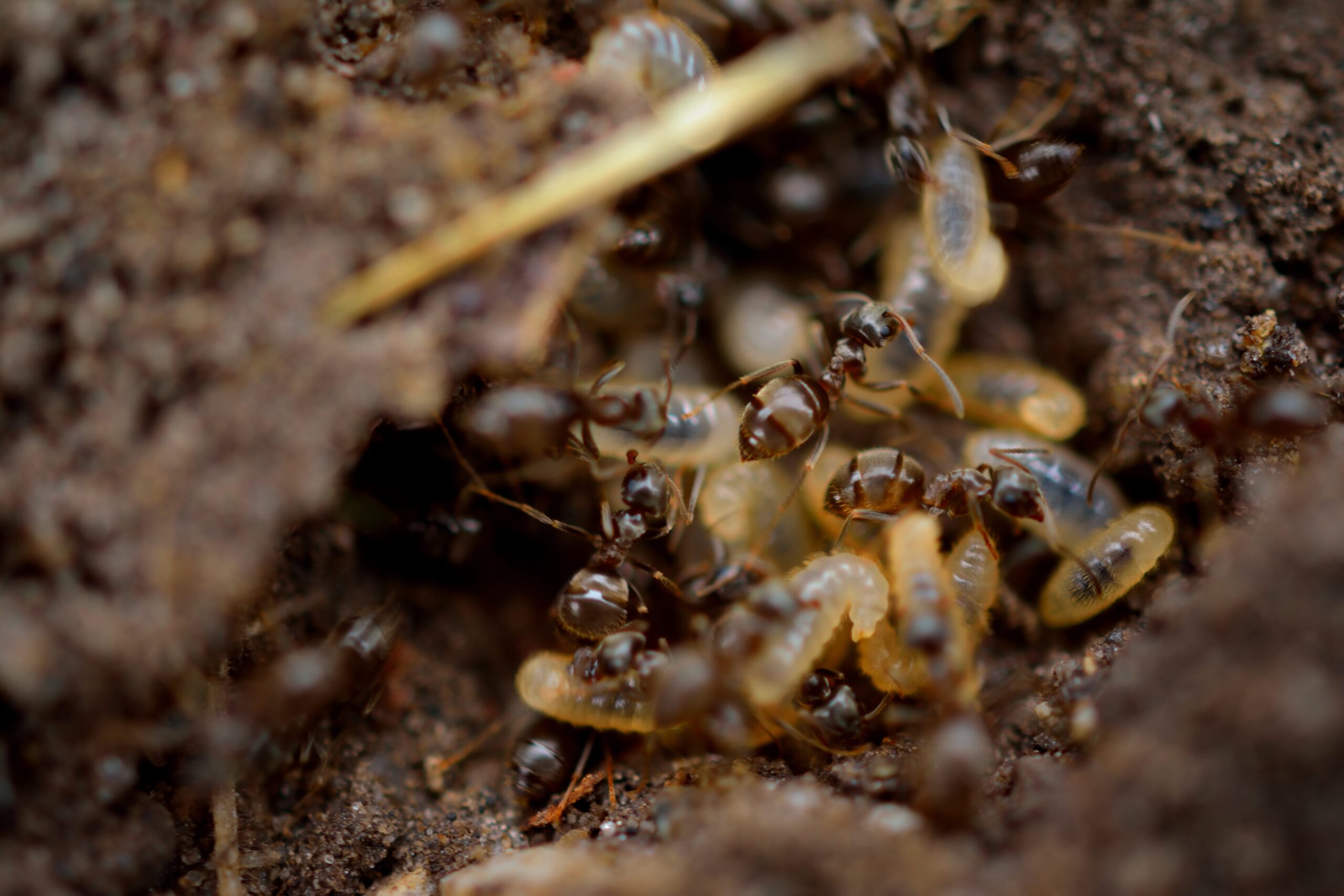

  • Lifting the lid of the termite farm

    Lifting the lid of the termite farm

    I recently had a disappointing experience where I got some disturbing clarity about a number of things.

    It’s painful to realize that others have used you and your private expression over a number of years in order to support their own psychodrama, casting you, baselessly, as a perpetual villain while they get to take turns being victim and rescuer in relation to you. They never saw you as a person or with your own needs, just an object to be used for their own purposes. They have entirely taken leave of external reality, or the realities of their responsibilities and your needs.

    It’s like lifting the lid off of the termite farm of someone else’s relationship and seeing all the grotesque, codependent, self-feeding paranoid ways it functions.

    When we were children, sometimes my little sister would bite her own arm, leave bite marks, and run to my mother to say that I’d bit her to get me into trouble. This was the same sort of experience. Now I see that some women never grow up, they just need to be the victims. Even someone I never had anything whatsoever to do with has felt the need to jump into the victim basket and fabricate injury.

    When all the while, because of their abuses, my own relationship has been stressed and has suffered. Supporting a traumatized partner is no joke, and not for the faint of heart. And I’ve been incredibly fortunate in that my partner of 15 years genuinely wanted and encouraged me to grow into my own integrity, to fight my own battles, to take responsibility for my own life and actions. I chose well: someone who had found these things for herself, and only wanted to see me rise and grow into myself. Someone who wouldn’t feed my fears, insecurities, or worst parts. She gave me encouragement to live with integrity, and I have felt so bad that she has had to deal with all the baggage that the injuries from the abuses I experienced entailed: trust issues, fear of groups (from the mobbing), fear of being used and exploited in relationship, despair, intrusive memories, or just not being able to be present as I wanted. These things at times kept us from creating the scope of world we both desired. She didn’t deserve any of that, but still hung in there with me as long as she could.

    People who don’t grow up can spoil careers, jobs, lives, cause enormous and lasting injury through their abuses, and still, in the middle of retaliating when their victims complain or hold them accountable, feel that they are the victims who deserve to be compensated by their victims for the stress of being held accountable. There are just no words.

    Academics lie, more than I had ever thought possible. They build whole formidable scaffoldings of lies, which they then pull out and push to achieve their agenda, making it seem like historical truth when most allegations are entirely baseless.

    With the villianization, lies, and total disregard for my personhood, needs, boundaries, no wonder others treated me as they did. And I was blind to it all, I had no idea what was happening, or why. Because it was all behind my back. I was slimed.

    To have some of one’s bravest moments and biggest steps into integrity contorted into how those people need to cast them for their own small world, a fear-based, paranoid world which does not grow and does not allow others to grow, really puts into perspective how much I had wasted on people who have no interest in changing or growing.

    That’s no place to share one’s treasures.

  • A Culmination / mythologies / Maybe being jaded isn’t so bad

    A Culmination / mythologies / Maybe being jaded isn’t so bad

    Some life points are more pivotal, more decisive than others.

    Things build over time, a culmination of moments, hours, days, weeks, months. Sometimes things can brew. Sometimes fragile things grow. Sometimes there are thin spots, where every moment feels intimate, fleeting, leaving one in gratitude. Moments that only happen because of a drooping openness, a building towards the sky, a deep relaxation in the peace of safety. Something which just is there. That belongs to nobody but also only to those who experience it. A precious space. A respiration. Something that just needs to breathe, to unfold in its own time, as any willingness allows, a gathering that could, would go in so many fruitful directions. Something which needs and deserves support, nurture. Something that we had not planned, don’t know if we’re ready for yet but there it is.

    Sometimes other things happen that are seismic, that click all the survival gears into action. That throw one into management. When one day one parent announced to me, in crisis, that they were having an affair, I sprang into action to try to help. My other parent was devastated and stopped eating for two weeks. Before my eyes, a marriage of 25 years (I hadn’t been there for more than a few weeks of the year for the last 4) collapsed suddenly. There was no safe ground. Along with it, my understanding of my family, my parents, relationships, started to become upended.

    It was as though, looking across the great plains, I could see a thunderstorm brewing, the ground starting to shatter, and both the sky and the earth coming for my one precious thing, my culmination. I became frightened that what had happened (although I experienced actually no feelings that I can remember at the time, just foresight) would destroy my ability to trust and to relax in the peace of that space, to even be able to access it again, to believe in love and to trust another enough to be willing to surrender to them. This was to me a sacred space that I’d never uttered about. But I became afraid that unless it became uttered, it would be lost, inaccessible, and I would never find it again. And I thought that if I uttered it, threw it over there, I could go away and go through all of the devastation and return and maybe it would be safe where I threw it, that it could be reclaimed after being held safe, after I proved myself. I had to prove myself trustworthy, good for it, achieve mutuality by climbing into my own actualization. Maybe I could come back to it, reclaim it, come home. I knew I had to do something to throw it out ahead of me, to go towards it following the band of comet light it threw off.

    Or did I actually take it, steal it? Did I take it or did I leave it? Or was it split in half? I only know that while out at sea it became a buoy, a lantern, a thing I wanted to support as much as it supported me. Something that said always: “swim away, yes, but find your way back.” A thing that connected with celestial events, wave crests, filings of the moon, and other invisible currents. It seemed like everything was wrapped up with it somehow.

    So we throw words out, against the wind that’s blowing where we stand. We throw an ice axe into the ice cliff to hold our place while we fall down the rope. We try to set a marker: this is my best, this is the best of me, this is the best thing I’ve ever had, this is what I want, this is ground I need to peg to. We hope that we have chosen well, that the axe holds, that someone is on the other end of the line. We do our best to avoid choosing hastily, cheaply, unwisely. Then we jump into the abyss. There are actually abysses on each side: the abyss of the unknowns of being together, and the abyss of being apart. It’s easier to let someone wiser than us help choose which abyss better suits the moment. At a moment like that, one doesn’t see anything other than drastic options, but is held by the idea of walking with a light within / walking into the sun. So it doesn’t even look like an abyss.

    Or is it a moment of wanting to choose our pain when confronted with pain we didn’t choose. If I have to have pain, I want it to be the pain of my own relationship, of something I can actually fix, of something I have some part of control over, rather than pain I can’t choose and can’t control. If I choose pain, I choose my own romantic pain, not my parents’. If this is a pain which will change my life, then I will choose how it goes. And I will open myself to all it entails. And I will take my vulnerability there rather than backwards into my parents’ relationship. And I will fucking fix it. I will fix it myself. I will cause the breach, then I will fix it. Because that is how I will show that I am not someone who cheats, who shies away, who has an affair, I will show that I’m not like my dad, I won’t walk out, I am a show-up person. And I’m not like my mom either, I won’t crumple up and give up. I will be worthy and can even out the playing field with my own actualization. I will have integrity. I will take responsibility.

    And then we are reasonable. Ok, I have my internal drama but there’s someone else out there involved now. What can actually be expected. What is reasonable. I move my deep trust to the top shelf, ignore any other lower desires that were waking up for the time being. Professional. That’s it. That’s reasonable to expect, that’s where I’ll put all my trust. I can absolutely trust professionally. We don’t have to get to personal. Honestly the thought is overwhelming. What would she want, could I even make her happy. And ew, bodies. Scary, but what would it be like. Nevermind. Cuddle. No not even that, nevermind. I’ll just hang out here in the shadow of this rock of professionalism, where I am safe. I’ll curl up here, recover, go forwards. Here is where it’s safe to be.

    I plot my return. I need to become worthy of what I have said. Re-hide the hidden thing by holding it between us in the folds of striving. Let it fall back to the bottom of the lake, the hidden anchor. Be responsible. Have to stand up for it, own it, show up for it. Can’t just throw words like that out there and leave it there. Must have integrity. Words matter. My belief in words, in language became shaken in the intervening time. But far off, the idea of returning as worthy beckoned. Climb down the canyon, climb up the canyon into new words, new language, stand on solid ground, show up, reach parity by building my skills and standing. The task was clear.

    A personal mythology takes hold.

    Survival: spread your weight out on the icy lake to avoid falling through. Find others to support you so you don’t fall through the cracks. I spread my weight out on the ice, across people, and tried to creep forward back to safety.

    And then: crash. After all that time, I discovered that throwing the thing, securing the ice axe, having something to return to, was all a failure. A total, abject failure. And even worse, it had been taken wrong. So fucking misunderstood. As painful as an axe splitting me in half. And even worse than that, all of the gifts it had seemed to confer were actually deligitimized, gold turned to ashes, not admitted. All of the glowing things had only ever been in my imagination. And me, demonized. Everyone else was on a different channel, different discourse, and I was doing it all wrong. My tender, vulnerable parts, turned into weakness and game for attack.

    And that very precious thing, trust, had been destroyed at home, at home, and also at home. At every home.

    At some point, I probably had to come out of that personal mythology. I had to uncurl, face life differently. If that hadn’t gotten me, something else might well have. The stars are still so tantalizing. It’s still so easy to imagine constellations of how it was supposed to shape up. Out there, up there. And during the day there’s just a lot of uneven ground to navigate. And so I do that.


  • the mess

    the mess

    The first time I had ankle surgery, it was on accident. I had had no choice but to trust the medical personnel taking care of me, at a point when my trust in institutions and helping people in general was pretty low. I was really lucky to land in excellent, compassionate hands with my surgeon. A catastrophic physical experience turned out to be healing on many other levels.

    This time, surgery is happening on a voluntary-but-needed basis, and I have been sort of surprised by the psychological preparation I’m finding I’ve needed to do alongside the logistical planning. There are all the surface-level fears of things going wrong on the operating table, infections, etc., and then all of the other fears involved in trusting other people with one’s life, being at the mercy of others.

    The other thing that’s happened more recently is having rolled a big stone of shame off of my body and realizing it doesn’t belong to me. Getting rid of that has allowed all of these other things to emerge, like they were snakes plugged up in a hole in my stomach. On the one hand, they have been fairly frightening to contend with and slippery to grasp, uncontrollable at times, and consuming more of my resources that I’d like.

    On the other hand, letting them out has cleared out so much space and made me so much more fully human. A lot of them are emotions I wasn’t allowed to have or could not allow myself to have at the time of the incidents, for one reason or another, usually because survival demanded something different, and because they were totally obscured by all the hot dark burning shame for just being or for not knowing. Letting those emotions run their course now has been difficult, it’s sort of happened spontaneously and unexpectedly like a geyser that just opened up to the sky. At times I can barely keep up with them.

    I’m positive that there’s a lot more I can learn about dealing well with them without also affecting others, but on the whole it’s been a cleansing process which has brought more internal compassion and tranquility. I don’t know if or when it will be completed, but what I do know is that these days it’s been really rapid.

  • the brain as it is

    the brain as it is

    Sometimes one rolls all the way back down the mountain in a snowball of old junk, into old realities which block out the new and sabotage hopes of renewed peace.

    What I’ve had to acknowledge is that through some of my experiences, my brain changed and I have to be continually mindful to manage it well. Otherwise when my energy and/or inhibitions are low or stress is high I cannot regulate it. I simply can’t access that space where one steps back and notices one’s responses to whatever streams into consciousness like it’s a film. Sometimes I still need to find new tools. While others might be able to tolerate high-stress situations or an influx of chemicals, hormonal or other, without issue, I’ve learned that I have to be more careful and make sure to have things that keep me tethered to the here and now in order to avoid having everything feel unregulated, unfiltered, out of control. I have to avoid anything which could make it worse. I have to stop searching for answers which aren’t available or trying to imagine ways to fill in the gaps between disparate events I haven’t understood on my own.

    There was a time when I was just numb and for both internal and external survival reasons couldn’t respond to anything emotionally as it happened, but this just meant that those responses became eruptively protracted later on. There was one summer after some events where I was just in a big void of understanding what had happened or support and just sort of sank emotionally. It’s been terrifying to think of that happening again as I’ve branched into my new living situation, and even have a learning opportunity which is totally different from yet still somehow echoes a learning opportunity I had that summer, but because of some overwhelm hadn’t been totally able to take advantage of. Although I know that my course of study now isn’t nearly as challenging, I’m still absolutely terrified of failing or letting the people who helped me get the opportunity down.

    This has been hard because at some core level it conflicts with my survival myths, that I should be able to manage or gladiate anything, that I’m in control, that I’m low-maintenance and don’t need to demand a lot from others. That I’m not someone who could become too scared to cry, that I could not be immobilized by shock. That I should be able to wrap my head around and puzzle through anything. That I can find the answer. It can be hard to get any distance in the sense of temporality, to realize that at this point I’m better resourced and better connected than I was before, that I have more tools, that I’m less isolated, that my human experiences are just part of the experience of being human, and that something about that is sort of beautiful.

    There’s a fine line between learning about how an altered brain and psyche function and having this information lead to despair or hopelessness. But the other thing I’ve learned is that not acknowledging what’s going on just leads to longer term issues. It’s really unsettling to find that one’s rational mind is not always in the driver’s seat. I just have to try to have faith in neuroplasticity to be able to restore some of what was lost with the proper approach and support.

    One example has been my ability to concentrate. I used to be able to sustain long hours of very deep focus and a sense of connectedness to life without much effort, but during times of upset this changed. I was trying to learn a challenging language and to turn out long papers and was having such a hard time sustaining any focus, which only led to more frustration. One well-meaning professor once told me after some big events that she noticed that I didn’t seem to be able to focus. Instead of saying yes, I have not been able to concentrate and am feeling totally overwhelmed, even violated, and do not feel I can escape, I just felt that it was another way I was failing and tried to become more buttoned up and streamlined and commit myself to the charade that there was nothing wrong, that the ground was solid after all. I had wanted so badly to show that I could endure and handle it, that I was worthy of support. It was sort of like trying to walk or even run on a broken limb and enormously frustrating. In retrospect, I really ought to have taken a little time out (although for many reasons this seemed totally impractical if not impossible at the time) to regroup myself, to have pulled myself away from circumstances which only made things worse. But there still seemed to be shells in the shell game to turn over, maybe I would find what I needed if only I guessed the right combination of words, cracked the code, found the underlying logic. Sometimes the answer is not in the problem after all. But scary to confront that void. All of this has meant that it sometimes just takes me longer to get through my work or a book or to put myself back into the driver’s seat, and to remember that it’s always worth trying to get back up again.

  • hollowed pride

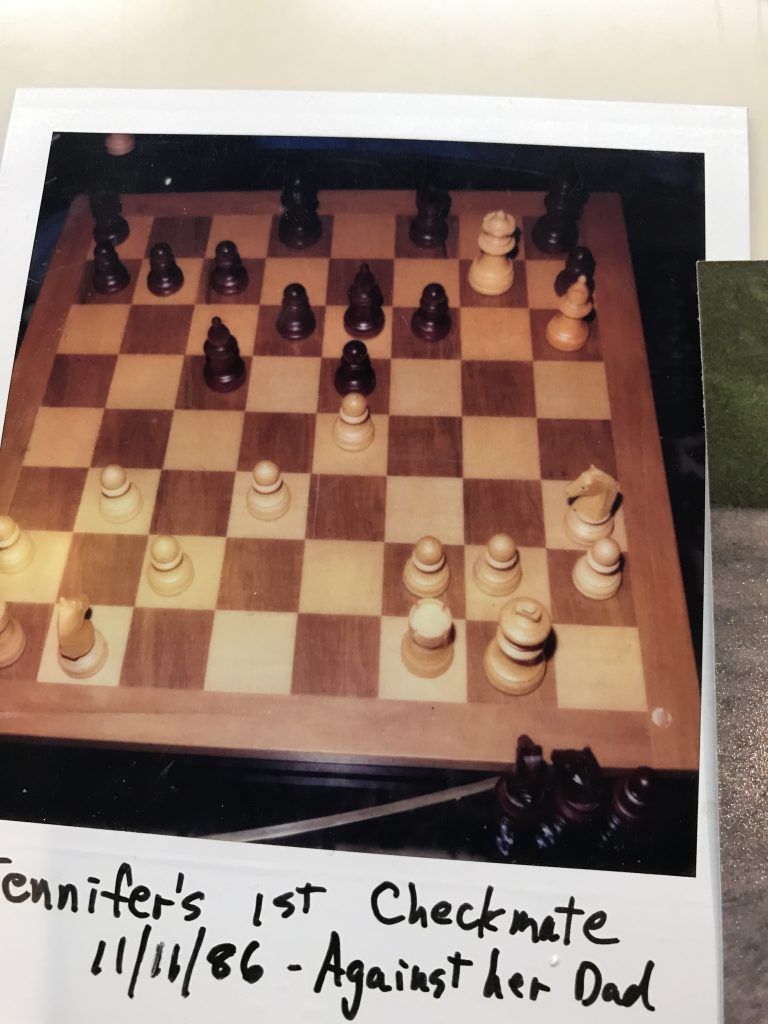
    The above image chronicles the last time I played chess with my dad. I was almost 9 the day that I beat him. He snapped a polaroid, bragged about it to others, and never played with me again. Eventually I found other people to play with, one friend who was a boy, and mostly boys in my high school chess club who were seriously tournament-playing with a timer during lunch hours and more interested in having me as an audience member etc. than letting me play. I didn’t really pursue it much after that as my attention turned to other things. What’s funny is that my grandad, my dad’s father, taught my grandma to play. And she beat him the first time she played him. He actually threw chess pieces around the room and never played with her again. She took up Mah Jongg with her friends and won almost every game. In her assisted living home where she went to live after my grandad passed away, they had games of skill and chance, and she won both unapologetically almost every time.

    But back to my dad, he was a tricky father to grow up with, and it’s almost funny to look back on some of my times with him now. He would confide in me about his problems with my mother, and tell me when he thought she was being unreasonable with me. My mom liked to describe him as having a touch of Asperger’s and to this day, almost two decades after their divorce, won’t concede that he was also narcissistic.

    We did some great things. We went on one scuba vacation when I was 17 or so, and my dad was upset to learn that I used less oxygen than he did. We were dive buddies and at one point under water, he came close to running out of air. He swam up to me, with a panicked look at one point. I suddenly realized with clarity that if he were to run out of air, he wouldn’t think twice about taking mine. We ascended to the surface, but the realization shook me for awhile after that.

    As I grew and had opportunities, he wanted to join in them. 8th grade math club – he became a parent club leader because he wanted to do the math problem sets. Though I was supposed to grow up to be a chemist, physicist, or doctor. No other professions were considered valid. Asian Civilization class in high school: he took my books from the class, then took himself to China. He has not yet returned my books. He also took my books from Spanish class, and then had an affair with a woman from Latin America the summer after I graduated college. “Jen, this family is broken. I’m having an affair with a Sandinista from the coffee shop at work who has an AK-47. Should I tell your mom? What should I do?” When I took a sailing class, which I hated, he bought a Laser sail boat, took me out on the mountain lake that could have stiff winds without knowing how to sail himself, but wouldn’t let me steer. We capsized three times. A storm came up, and someone in a motorboat came out to rescue us, which was humiliating for my dad. I was hypothermic by the time we were rescued and had to have a rescue blanket.

    One night, after I’d found my girlfriend in Portland, I talked on the phone with him after he’d had something to drink. “I have to go eat dinner” I said. “Don’t eat the pussy,” he said smarmily. “It’s really gross.” He hates cats.

    Every weekend when I was in high school, we would go together as a family to the mountains on my dad’s prerogative. There was no way to opt out. We had to be ready to go by the time he got home from work on Friday night or he would throw a fit. I missed all the high school parties, never even tried weed till I was halfway through college. Because I was coming to terms with my lesbianism, I didn’t totally mind missing all the high school social events, but I think I could have used more of a social life. At that point nobody was out in high school. By the time my sister reached that age they were more relaxed, letting her bring friends up or spend the weekend with friends instead. Perhaps they worried that I was gay because I hadn’t been allowed to have more of a social life and wanted to make sure my sister wasn’t so locked down. Summer camp was incredibly transformative because it allowed me to have a time and place to develop friendships and forge a connection to the mountains on my own terms, without my dad controlling and mediating the experience, or the forced march of the hikes he chose. When I would challenge him, my mom would implore me to stop being difficult and stubborn.

    When I was a senior in college and came back for vacations, I realized that I’d emotionally outgrown both of my parents, which is a bit of a shattering realization to have. They told me they thought that what I called empowerment indicated only that I’d been brainwashed at my women’s college. My mom still hopes that I’ll realize I’m straight. But the transformation of that last magical last college year, when everything seemed to coalesce and integrate and I found the start of an academic stride and belief in my abilities stayed with me to a point as a new way forward through life, even if it has at times come into question, or something I see now as more of an idealized vision than of something which can correspond with external reality in all ways I’d hoped, and the double-edged fortune of being able to grow into such a supportive environment – so difficult at times to re-create or to validate in retrospect.

    My dad and I still occasionally try to have a relationship, but then it all flies south. It usually starts with my dad showing up with a grand financial gesture and an idealized vision. A trip to Europe, where I will do all the interpreting. A bike trip to ride the French Alps. A ski day where he can be proud that I ski like he does. When I turned 40, it was a mountain bike trip – though it had to be one he chose. We went to Moab for a 4-day bike of the White Rim. I was a strong rider and could stay at the front of our group. My dad, who had become deeply interested in geology (a room in his basement is now filled with rocks and he has three different geology microscopes), took his time to look at rocks and stayed close to the back of the group. On the penultimate day of this 4-day ride, he exploded. “You little bitch,” he confronted me on the rim of the canyon. “Can’t you see my hip hurts? I’m at the back of the group. Selfish ingrate. You haven’t biked with me enough. This is our last trip together. I don’t ever want to see you again. And you’ve gained weight. You’re my biggest disappointment.” I calmly told him that I believed that he had been looking at rocks and had been happy taking his time, and that everyone is only competing against him or herself. “Shut up.” he said, suddenly afraid that the other group members would hear. We ended the trip, and he didn’t talk to me at all during the whole 6-hour car ride back to Colorado. “Have a nice life.” he said as he dropped me at my mom’s house.

    Over time I’ve come to understand now that he has very limited emotional bandwidth and not much room to operate outside of picking up his marbles and leaving the playing field when he doesn’t win, but that doesn’t mean it doesn’t hurt every time. On the other hand, my dad never had many others standing up to him or stayed in situations where he was confronted. I was someone he couldn’t escape who did stand up to him, and one time he told me that he thinks I’m one of the strongest people he knows. But there was always a price for it. I’m definitely the black sheep of my family.

    I think that my experiences with my dad compelled me to try to find a different way, also set me up to understand that sometimes success comes with hidden costs and agendas, that sometimes gifts are for the giver, that some battles are more worth fighting that others.

    What threw me was thinking I had found something different in my ideals about academia, which felt oddly familiar though I couldn’t explain why to myself at first, only to realize that no, others do not always support or welcome or honor one’s success, and actually this sort of blindsided me because I thought I’d had better judgment than to let myself in for more of that sort of pain. At first I didn’t understand why some of the older grad students seemed to make a point to keep their heads down, to underperform. I thought it was sloth, or maintaining a status quo. I didn’t fully appreciate that it was a sort of compromise for survival, and that, being idealistic, I was not somebody who could live well or non-self-destructively with making the sorts of compromises one often has to if one wants to survive where there are hard edges of people at play. The shame, fear and anger of tolerating unfairness or abuse could eat me alive. Which sort of leaves one floating in a no-woman’s land of not knowing anymore what is safe or who to trust, and unwilling to throw more effort at it.

    It’s always been easy to try not to be narcissistic or repeat those patterns, but it’s been hard to unchain that from also not having success. Like if one has success without power one gets squashed, but success with power makes people narcissistic through some mysterious alchemical process. Which I know is false, and certainly there are enough examples around of successful people who don’t need to take others down, but somehow it’s still hard to believe.

  • “intersubjectivity”

    “intersubjectivity”

    I’ve attended several virtual events this past year, and some have stuck with more more than others – those that have inspired me, or, alternatively, provoked me in uncomfortable ways that have continued to bother me or simply make me want to gag; as they say, if you see something, say something. So I am saying something. Here.

    During the GSA I attended a number of panels, some I had time to scope out in advance, and some I relaxed enough to jump into on more of a spur without looking too closely at the details beyond paper titles and presenter names but because the subject matter interested me.

    One of these latter experiences was a panel about Asian film, and I was sorry that I hadn’t avoided it. The first presenter, who by virtue of affiliation, which I noticed later, is one of the kind of injurious human missiles I try to avoid. The sort of people who had all been included and helped in situations where I was excluded or abandoned, who I knew had too much at stake professionally to make it worthwhile for them to stick by me. That presenter was discussing a lesbian film where he went into sickening detail over several very graphic sex scenes involving the protagonist with both men and women. It was more like a “how to feel empowered in the bedroom” talk. He made frequent use of the theories of Jessica Benjamin, who wrote a book called The Bonds of Love. After hearing more than I wanted, I had to leave the zoom room entirely though some of the later presentations had initially interested me. I just wanted to throw up too much.

    The Bonds of Love is a book with which I’m well familiar, having read it in its entirely in college and then used for subsequent graduate school work. The book and its contents were something I would later identify as tools of seduction: seduction into a false reality and false sense of power, seduction into an illusory relationship of equality with someone who had very real power over my career, seduction into a false sense of self and false beliefs about my abilities, my qualities, my potential, my work, my concept of the world, my self-concept, my future.

    This book was written by a practicing psychoanalyst to be used within the context of the psychoanalytic field, where ideas can be put into practice. In this context, the book seems to implicitly assume a frame of reference which includes mechanisms used in therapeutic settings: a therapeutic frame, boundaries, guidance, accountability, a therapeutic toolkit including both traditional and alternative approaches, oversight licensing organizations.

    The idea of intersubjectivity within a power relationship allows the professional, who has an already established fiduciary relationship with the power-down person in the context of an institutional and societal framework, to ignore or step outside of the socially ascribed power and establish a dual reality with the other. If that seems unfair and that that the theory operates by directly acknowledging hierarchy and proposing something better, I would say instead that maybe it tries to hack the tyrannies of hierarchy and sit on top of it, but it actually unilaterally changes the nature of the initial contract already established between the two people at hand. Because the power down person can’t be expected to know the full risks to themselves of changing the social and professional contract in this way, they can’t really give meaningful consent to this change. So by necessity it must operate alongside the established contract, and also within it. But the nature of intersubjectivity is that it dismantles the hierarchical structure, and, with it, the frame that creates safety. So any newly established safety becomes a matter of interpersonally developed rather than socially ascribed trust. It becomes more private. The entire relationship becomes more personal than professional. Being treated as an “equal” and as someone who is granted cooperative power in managing the interpersonal boundary and power of the professional as the power is shared can give an enormous boost to the confidence and sense of personal power of any aspirant of what the professional offers. It is very, very, very heady. It’s on the one hand easy to get carried away (or to run away) with, and on the other allows the professional to disavow any responsibility or accountability for owning or using the socially ascribed power, and to avoid the discomfort and tension of occupying a place of professional responsibility. The tools associated with the institutional, hierarchical power are always, however, available to the person with more power; ignoring them or pretending that they can be overwritten with a more private and cooperatively established power dynamic doesn’t make those or the larger context of socially ascribed power go away. But it is all too easy, too attractive, too compelling to get carried away by – and even live in or foundationally base operations out of – the dual reality of shared power and to forget about the brass tacks of the hierarchical underpinnings.

    Erasing the boundary also increases rather than decreases the vulnerability of the power-down person. The personal touch in the context of the duty of care makes the relationship instantly more evocative of parental relationships and in this way almost explicitly invites and welcomes meaningful transference or other meaningful emotional connection into the exchange. It opens the door wide for things to become personal. However, the responsibility for managing any resultant responses or feelings becomes shifted entirely onto the power-down person while transpiring within the external frame which establishes the power of the power up person, and with it, a false sense of safety because the power-up person has actually abandoned the frame though this may or may not be apparent. While the external structure is still there, the safety it offers becomes an illusion as it’s been tunneled through by the removal of the boundary. It’s impossible for the person in the power-down position to fully see and appreciate that while in the structure, until the effects of violative behavior emerge. Especially if the power-up person is neither interested nor willing nor equipped to manage the frame, the feelings, the possible transference, the power, the consequences. It becomes all too easy for any unwanted results of the invocation of what can be a very volatile space to frighten and cause the power up person to simply reach for the socially ascribed power, pull rank, and terminate, stranding the power-down person alone in a very confusing, harmful and dangerous situation.

    At this point, it all comes down to integrity and trustworthiness, because by then there are so many bombs ticking away that it’s impossible to account for them all. In fact the person in the power-down position has effectively had a number of bombs strapped onto their body which can be set off at any time in other circumstances. They have been tricked into eating poison. The bombs need to be defused one by one.

    If the power-up person is unable to manage or seek guidance for managing the frame, but is also unable to manage their own and the other’s natural responses, the power down person has a lot to lose, as they do in any power up/power down relationship. However, when that space becomes an intersubjective space, the losses can become very personal and much more extreme and devastating given the very high level of vulnerability and exposure. The very frame that was supposed to protect the power-down person becomes used as a weapon to harm, to chop off limbs, to annihilate, to grind under the boot as the realities of the hierarchy become the newly defining parameters of the relationship, in a whiplash of mental, psychological, institutional, and financial abuse as the dual reality becomes disavowed and discounted, the underling dismissed as inappropriate, crazy or too imaginative or disconnected from reality when abandoned alone in a space which effectively isolates him or her from the external frames of understanding. Trying to operate alone in a hierarchy as an offshoot of a grounding in intersubjective space doesn’t really work unless someone can catch you on your flying trapeze, acknowledge the space, and help ground you in a more integrated sense of being and of power; the chances of that actually working seem to me to be approximately one in 17 million. The odds for it ending in harm, frustration, and failure however, are much much higher as the person has been stranded is stuck in strange positions – inside out and upside down – and blamed for it while wiggling around attempting to grasp what the real reality is and to try to ground her or himself. Who in the world would willingly pay money for that experience, or consent to experimenting/being experimented on in intersubjective realms if they knew of those possible losses, possible harm with effects that last well into the future?

    Also, because the injury is relational, it’s impossible for someone to address it alone, and the injured person is made responsible for dynamics that they couldn’t actually control as the mechanisms of hierarchy and power work against one, and there are other hidden elements.

    One way that a different person, who had been the principal person who had blamed me for being inside out and upside down, tried to address it after I returned from studying abroad was by creating a second subtextual reality through parable that didn’t really address the first, but that isolated me apart from the rest of the class in the space of her prior violative comments, but never explicitly so. It then became unclear how I was supposed to respond: write my paper on the same grounds that the rest of the class was operating within, or write the paper that in some way responded to the second subtextual reality, which was a really scary prospect. How was I going to be graded if the only way I was allowed to be acknowledged and participate in the classroom was within the narrow band of the second dual reality she had created? I wasn’t ever included in the larger class discussion. It wasn’t an apology, it was a controlled, forced environment where the ways in which I could respond were severely limited as she controlled my grade. It also did more harm because it isolated me even further from the rest of the class when I wasn’t allowed to participate fully.

    What I actually needed was acknowledgement and validation of the first dual reality, the intersubjective space by the other person involved. There was so much I couldn’t see and couldn’t know because it had been hidden from me. Hidden agendas. I needed those to be made clear. I needed to understand what was real and what was not. I didn’t understand what had happened. I didn’t understand what was going on. I didn’t understand what my options were. I didn’t understand what I had lost, or had ever really had. I felt so deceived, so played, so betrayed. I needed someone to work through it with me. What happened instead was that I was backstabbed and discarded. I was blamed and hated, simply for being. I didn’t understand what I had done wrong. My entire sense of reality was completely discounted again and again, and another, strange and harmful one was shoved down my throat as a condition of my employment, and I was sort of dismissed as some sort of head case, which in turn caused me to swallow my responses and prevented me from getting the sort of support I needed. Added to that, I felt that I had to work harder than everyone else and had no room whatsoever to mess up just to justify my existence.

    So what about the use of psychoanalytic theory to discuss film?

    I believe a failure of the book is that it fails to discuss the psychoanalytic context and frame and the safeguards for the responsible use of what is a very powerful tool. As always, when adopting tools from different disciplines, it’s really important to contextualize those, and also to be really conscious and wary about how they’re being deployed. So much of the work of thinking about literature and film is thinking, feeling, searching for shared experiences, experimentation. It’s so natural to want to play what what you’re learning in different ways. And it’s so natural to want to play with fire. However, without the tools for creating safety and evaluating appreciable risk also deployed in the same discussion, it’s all too easy for things to become just another gender reveal party gone wrong.

  • Freeze / Melt

    The ice storm of a week and a half ago turned out to be the most destructive weather event here in the last 30 years. I didn’t ever really have a moment where I felt endangered, but going through the motions of survival was probably good earthquake preparation. Being disconnected from the internet was a useful jolt reminding me how the wired world had gotten into my veins. It was a great time to catch up on reading, and to let the circadian rhythms reset as all the windows in the buildings were truly dark at night and the low-level buzz of electronics, air purifiers, etc. absent. We weren’t out of power so long that the novelty and fun of solution-finding and adaptation wore off before it returned.

    I had nightmares, mostly about being abandoned. In one very visceral and vivid one, I was wordlessly left alone at the parking lot of a movie theater and had to swim against a current of people to reach the ticket desk to buy a ticket I didn’t have/didn’t know where to get. I didn’t know anyone there. Except for the ticket-seller/taker, the receptionist at the first language school I had taught at in Berlin. I didn’t even know what was playing, just that it was par for the course that I would drive my car to the theater and attend. It was a sunny afternoon, somewhere in suburbia in the U.S. The person who had been a passenger in the car I drove got out as soon as I parked and I could not find and never saw her again. When I woke up the sun rose and life went on, but the emotions from that dream continued to swirl.

    After the world became again “vom Eise befreit” and things like hot showers, machine reboots, a tank of gas were taken care of, the hard part started. It was very difficult for me to switch gears out of survival mode, like the gear was jammed, stuck. The world wasn’t appreciably less safe, we still had a shiny new president, a generally working infrastructure, I still had work, housing, warm meals, company. But I still found myself feeling jarred, jangled, anxious, empty, at loose ends.

    It was like when all that ice melted off it left me with raw nerves that no longer knew what to do. Even though the freeze itself wasn’t really terrifying at all.

    Since then I’ve been swamped with more old junk that I thought I’d cleared out, but apparently not.

    I started thinking about how past journeys or endeavors I’d taken on had later been revealed to have been based on living in what turned out to be false realities or false sense of safety, or foundations that were more air than ground, and how reluctant I’ve been to undertake big things given the new awareness of the likelihood that I would not be allowed to return, not allowed to find my way back, that “home” would evaporate and not recognize me upon my return, or that the safety is an illusion. The sensation is sort of a sea-sickness from behind, like a moment you realize that there’s no water in the swimming pool you’ve jumped into, or a dream when you are flying and only mid-flight realize that you don’t actually have wings and thus drop out of the sky.

    Feeling still that the emotions were out of proportion to my life, I’ve also started looking at where this may be rooted in things I can see and those I can’t, even ancestrally. I’ve been thinking a lot about my great-grandmother, whose home town became occupied (or restored to its owners, depending upon how one looks at it) and city renamed after she left Ostprussia. I wonder if she felt anything similar in terms of the impossibility of a return. She did return to the area a few times to visit relatives who had become scattered around the vicinity, but she couldn’t return to the place she grew up. I’m talking about something different but similar to not being able to set foot in the same river twice, something a little more viscerally aching. It’s also not the space time passes through in Agamben’s bee. Maybe it’s more about being outside of a time which has passed, outside of inhabiting the home of oneself, or a stuckness like a foot trapped under a boulder. Hmm. I can’t quite define it right now, but it’s fairly terrifying.

    During one Christmas I spent in Germany, 2004 I think, my relatives who live in Hamburg, with whom I’d just a few months prior gotten into contact with upon moving to Germany again, invited me to spend the holiday with them. Being stationed somewhere for a year or two can make new friends hesitant to want to develop any deeper bonds, so it was exciting to connect with them. It’s fine to not know anyone and be free and edgy for awhile, but after the novelty wears off one searches for more sustainability.

    On the front edge of that experience had been another, one of those moments that you’re not entirely sure you imagined or not. A collision when I was out one day, but the person I collided with caught me from falling over with a hand on my upper ribs, just grazing my breast. I was reflexively caught off-guard, but not offended. It was an edge of something where I knew that if it were unleashed, I was not yet strong enough to be able to emerge intact on the other end of any crash, that failure would destroy me, that all of my plans would go out the window, that gravity would take over and my life would become one big mess, and I could get hurt or someone else could. It seemed a lot smarter to stay free and have some bier and to just skate on the surface, to hold onto what little sense of power I had. But that surprise steadying handprint followed by its absence was seared into my side, and I didn’t think about any repercussions for a long while. But maybe it wasn’t really a space for thinking.

    What did know was that I hoped, hoped, hoped that that encounter sprung from somewhere authentic. I had had an advisor who kept close tabs on me via others who had kept trying to force people into my life in sensitive areas in ways which were really uncomfortable and unwanted, sharing with them information that I hadn’t given her, leaving me out of discussions or decision-making about my own career, coopting my efforts, even personally attacking me. She was not able to show up for me in terms of advising, responding to me in class discussion (or even allowing me to speak) or returning work, but seemed to need to send others as proxies into a space I had not ever invited her into to poke around. She also tried (her position gave her the legitimacy to do this) to take control of and force my career, my narrative, to force who I could work with, to basically disempower and disenfranchise me from being able to follow the paths of my own interests and inquiry. To obstruct me from all that I set out to accomplish. Never a single word of encouragement. Infantilizing and also then very difficult to climb out from under as I was always on guard and always had to question who was doing what with my career and why, and to be on guard for the personal attacks she launched. For this reason it took me the better part of 2 years to begin to trust someone who was wonderful in many ways but with whom I did not feel an intellectual chemistry, who this advisor had forced me to change plans to build into a student conference, in a place that the advisor had changed the rules I’d played by fairly to force me to study. I really got slammed around, and I didn’t know why or who had initiated it, if she was a proxy for someone else, or acting out of her own place. More than once I wanted to scream at her that the people in the program were not her marionettes. But if I told the person the advisor had forced me to study with about my discomfort with my advisor, I risked retaliation.

    My Hamburg relatives extended great hospitality and took me to Cuxhaven, where first my great Opa and then later my great Oma had sailed off from. We walked along the beach for a long while. There’s a point called Alte Liebe and restaurants which look out on the beach and serve baked fish and Gluhwein. My great Opa had never attempted a return, but in the 1930s my Oma and my Grandad, then 13, had arrived for a visit and then departed again. Visiting that point of departure/arrival/departure into the future which had created me was an odd and interesting sensation. My relatives also brought me to Lubeck to visit the Thomas Mann house and the Niederegger Marzipan museum. My distant cousin, who is just my age, gave me a wonderful tour of Hamburg (including the Reeperbahn of course) and a copy of Buddenbrooks for Christmas, and my Aunt once or twice removed had knitted me socks. When I left, we traded scarves and hats to remember each other by, and still write letters. Lucky me to find that port of call.

  • Search for Clarity

    Even now I still search for clarity. Where did I go so wrong? Where was the point at which I stepped from safety into all the danger. How might I have kept myself safe, how might I have survived all that. What didn’t I see, and still don’t see? What didn’t I understand then? Not having any answers is its own special hell because it prevents one from having enough information to build a solid narrative.

    I remember the opening of a new space when there was a flirtation. I didn’t know what to do with it. My experience was so limited but I was curious. I sensed some unknown danger but I thought I could be smart enough, spry enough, to avoid any danger. After all I was a mountain climber and I knew how to watch the weather.

    Another in my position might have been offended, and still another might have jumped right in and let it be simple, transactional, stress-relief. I got stuck on trying to figure out if I wanted it or not. I’d gotten attention like that from others, mostly men, but hadn’t really been interested. But now? I was deeply flattered. It was a new experience to actually receive the attention that I deeply desired.

    The next sticking point was did I trust – for me the experience represented the unknown and I started to think about the nature of trust – what it was. Would I trust someone with my body, and beyond that, would I trust someone to the extent that I would know I could trust them to have my back during something like the Holocaust, hypothetically? I meticulously observed and picked up instances which proved I could trust and put them in my pocket until I had a huge declarative pile of stones to put on the scale for trust and little to place against it. I engineered little tests to kick the tires of trust.

    Also I had never really believed in my academic skills enough to envision myself as an academic as my life’s calling and when I got a boost by virtue of another’s declared belief in me, it was life-changing. But now I have to wonder: was that encouragement just pro forma, what someone thought they were supposed to say in that context, rather than any reflection of me and my skills. Or was it an attempt at recovery from an incursion which retroactively was identified as a misstep, and the academic encouragement was an attempted salvation of the task at hand. The belief in my skills that I had thought was genuine boosted me into a space of academic confidence, risk-taking, the development of my voice and value as a person. It had seemed to be just the thing that I had needed most. But now, in retrospect, it seems like I was just willfully living in a false reality.

    The thing was that only one person owned up to the fact that it was a false reality: my grad advisor, toxic as she was, did me the service of letting me know that I wasn’t a real fellowship student in the case of being deserving, that it was more a pity case. That my ideas were bad, that I wasn’t a good student, that my papers weren’t even worth looking at, that my thoughts on feminist literature not worthwhile and best ignored. That my needs were a nuisance, that I was always out of step, a dunce.

    And then there was the flirtation with risk and safety. At some point I needed to make this delineation for myself and decided that the academic route, the classroom, the intellect, was a place of safety and keeping one foot there, I could nudge the other foot out into the space of risk but return to the safety if needed. I could balance between the two. The structure supported it.

    The problem with that is that one goes in and out of structures. Sometimes the time’s up. And when that happened, there I was, in the place of risk, but also in a place of trusting. But that place of more absolute safety was something I was starting to feel locked out of, because it was situated within the structure. One had a sense of safeguards even if these were vague and even if one never used them – it was enough to know that they were supposedly there. So this inevitably led to a search to return to the structure (of academia) when I most needed a sense of safety, especially as my family crumbled and the world was at times scary.

    I was too naieve (and too lucky in life before that) to entertain the thought that institutions were not, by definition, places of safety.

  • candy

    In order to get my graduate degrees in the program I had been admitted to and chosen, I had to take classes in my department. I had no reason upon enrolling to believe that this would be a problem. But it was.

    It was the kind of abuse which is very difficult to describe and even when one does, one worries that one sounds crazy or will not be understood or taken seriously. And in a situation where others have already called one’s mental health into question it’s impossible to talk about. It took me years to be able to call it what it was.

    In retrospect, I can see that one of the main things my abuser wanted was control: of me, of the situation, of anything pertaining. And her job gave her that, but again and and again and again she overreached, in ways that were never actually about helping me.

    I took a class in grad school which would have been my cup of tea: women writers. But it became very strange very fast. I did all the reading. I came ready and prepared to class. I was interested in the material. The professor asked questions I was really interested in discussing. But when I raised my hand, she did not call on me. She ignored me. And called on students who had not raised their hands instead. I wondered if I was being too forward. So the next time I waited until the first two questions had been answered to raise my hand. But I was still ignored. And after a few classes she asked questions which were along themes I knew very well, so specific that it was almost like she’d gotten information about what I liked. And so it was like with the question there was candy dangling in front of me, but when I reached for it she ignored me, and made sure that it and the credit for answering went to another student. One time I did get to answer a question and she told me that I was wrong (though I had done enough work to know that I wasn’t), insinuating that I was stupid for thinking that.

    Everyone else in the class got to participate. I had been stood in the corner with a dunce cap and I never knew why.

    The one time I was asked to participate was memorable. We read The Piano Teacher and there was a segment where the student fancies the teacher and describes this. The professor went around the room and assigned students segments to read. She started in the middle of the room, and landed on me to read the graphic sexual segment, to read aloud and comment on. I was uncomfortable, but simply did the reading and stopped.

    I had to wait more than a year and ask many times before getting my term paper back. Other students I talked to got theirs back much earlier, and were allowed to rewrite for a better grade. I was never clear what my grade was based on. I was not allowed to participate in class. I was told I could not rewrite my paper. My ideas were never engaged with though I engaged with the subject material.

    I was a grad student and needed to prove that I could uncomplainingly hack it. I felt that my chits with other professors had been used up already on a conference in my program during my first year, someone else had already spent them for me to “support” me and I did not want to be a crybaby or needy (asking others to help me with my needs) although I didn’t know what to do. One professor had even reached out to try to help me. But I so badly wanted her to think of me professionally, to show her I could hack it, to be able to stand on my own feet, that I didn’t want to share my troubles. I didn’t want her pity. I didn’t see what she could possibly do to help me.

    I just stopped feeling safe, and I learned that I had no real recourse to address any of it if I wanted my degrees. I tried in four or five different ways to work around it but in the end, my program only protected my abuser.

  • Interregnum

    Interregnum

    Autumn is usually when a deeper, bereft sadness and sense of uncertainty and out-of-jointness has tended to surface, it’s just the time of year when hard or stressful things have tended to accumulate over the years and leave a heavy residue. Usually I don’t get through it without buying a few school supplies (though I’ve been out of school for awhile) and sneaking out a few times to smoke Djarum clove cigarettes, with the first one always bringing me close to either fainting or throwing up, and these actions somehow helped with whatever felt wrong. When I first moved to Germany in the early 00’s, congregating with others who had or needed “Feuer” was a great way to meet people and socialize. So it served a great social survival purpose (I always carried two lighters just in case the my first didn’t work), as well as being a daily flirtation with my own mortality that helped me to feel I was walking the edge of being alive. These days, my origami kayak fills more of that role – inevitably people are drawn to watch as I unfold and construct it or refold it, and in this way I meet people in suburbia; I spend more time talking with people than actually setting up or taking down my boat.

    However, that deep bereft sadness, cloves and school supplies have not been a part of this autumn. Which is strange given some uncertainties around a planned but still pending separation from M. Perhaps it’s a more global sense of being alone together in the covid19 era which alleviates some of the past isolation, or the gentle rise of worth and utility in the shared purpose of political and global activism and interest, or maybe the sadness that afflicts so many has made mine just a small drop in the bucket. But it seems like more than that, something on a subconscious level that feels very primal that’s been popped back into joint as the larger world order becomes more restored, and something else released. Like I could finally digest some things and keep them down. Like being bent over a pain for a long time and then supported in standing up again without the weight and being entirely new in one’s opened body, a sensation approaching holding an active peace. Like I’m more me. Before this season, I had been feeling bad or defective that I had not been able to heal, control or regulate some things on my own, and that the help I had found along the way hadn’t in fact been terribly helpful.

    Healing can be a tricky thing in terms of figuring out the space in which it transpires and who is involved. Following the ankle injuries that landed me in the hospital, my dad decided to make a visit while I was in skilled nursing. He wanted to bring his new wife, who I did not know well, and with whom I had very few positive interactions or associations on file. I did not want to see her while I was feeling so vulnerable and lame, and I did not want her to be the one telling all of my extended family members about my medical status. It felt like an intrusion. I just didn’t really have the bandwidth to deal with newish stepparent dynamics on top of everything else. But I did want the support of my dad. So I told him it was fine if he brought her along for his own support and to do things with in the city, but I’d rather not have her visit my room. This made him incredibly angry, he felt insulted that I was not as accepting of his new wife as he wanted me to be, so he visited for 36 hours and was cruel and pouty the whole time. So my solution didn’t really work for anyone. I would like to believe that I would, if confronted with that situation again, have the grace to have them both visit or ask them to postpone until I felt less vulnerable, but at the time it was also important to honor the little sense of control I could have over my space and circumstances. On the other end of the spectrum, I had a wonderful local community of friends which I didn’t really know I had before – I’d met most within the year via a meetup group and the things that spun off of that – show up for me in wonderfully supportive ways. Many who visited me also brought their potions, lotions and notions about how to heal and how they could help. One friend sent me blue light through the matrix. Another brought crystals, and a third tinctures of homeopathic remedies that she wanted to talk with my doctor about. So some of it was an exercise in finding diplomatic ways to say thanks but no thanks while still appreciating and connecting around the intention. I have to credit the support of M and of my community as being a major factor in why I was able to recover well. Well ok, M is more social than I am and played a big role behind the scenes of reaching out to mutual friends behind the scenes on top of visiting each day, so she gets even a lot more credit than that.

    Emotional healing is a different but related thing. The first time I went though a deep emotional healing, it really took me by surprise. It happened very organically and it “just was.” They say that during your 20’s, you come to terms with your family and work on seeing and separating from it. I had been taking a class which dealt some with literature that featured family dynamics somewhat similar to my own. But I think the much bigger contribution came from feeling seen, appreciated and supported in my life in ways I never really had been before and hadn’t known I could be – it had been a field of fresh snow that I hadn’t even known was there for someone to cross, like it had been in my blind spot all my life. Though it took a little time to warm up and although it was incredibly frightening to feel so suddenly vulnerable, I was incredibly fortunate to land in what felt like a perfect fit of a situation which unloosed, at warp speed, a Great Unlocking on more levels than I could count or could process at the time or have fully processed. Someone had taken my arm and escorted me across a bridge into a new dimension of being. After something like that happens, one feels a deep well of gratitude and then, creeping in, also a new fear of losing and having to let go of what now seemed essential and the New Way Forward and a search for ways to perpetuate it, as well as search for the words to describe this new place. And then if one describes it to the wrong people using some of the terms and frameworks available to do so, it is actually quite striking how unfathomably bad and evil it can be made to sound. It’s the sort of thing that one just has to be there for, but also absolutely cannot be abandoned within. It’s hard to just rest in the deep quiet place with it, where a knowing just surfaces as though from a deep spring – but in not doing that, in the search for explanation of something which “just is,” one risks losing touch with the quiet deep place and the agonizing, snakebit and fallen from Eden task of trying to recover it, which only drives it further away. Like those finger-trapping toys – the more one struggles to get free, the more tightly it traps the fingers. Maybe the big gift of covid is the stillness that lets us look into the water again.

  • just passing through

    just passing through

    I recently attended an online conference that was enormous, but the online format at this time allowed for a much more paced digestion of the content and general exposure.

    The experience has been valuable in understanding more about the structure of the field and academia, the current questions and the work being done.

    Some of it has been a treat in terms of having the opportunity to play with ideas about books I’ve read or themes I’ve engaged with at a higher level and to reactivate those neurons, some of it has been a bit jarring, sometimes surprising, and put a little ink in my pen. Sometimes getting a wider perspective on one’s experience also means getting a more granular perspective.

    I’ve also been able to listen in on the current concerns facing the field (and academia at large), most about survival, to look at the ways that the field is engaging with larger global concerns, politically, technologically, ethically, and a little bit about how the field is considering internal concerns.

    I don’t really feel like sharing much about my internal journey spanning various panels and their content at this point — maybe later — but do have a few contributions from my perspective.

    The Tech

    In spite of the conference taking place online, I picked up on an undercurrent of resistance and aversion to tech large and small. Which is totally understandable given that a lot of the tech solutions to the covid era have been forced, while other products distract from or impede the work of academia. Still other tech poses a direct threat to the authority of the higher ed model. And yet more tech threatens our tenets of democratic society in general. In addition, fields like digital humanities are just not taken very seriously or are not yet well-defined.

    What I think remains a blind spot for the discipline is the very real opportunity higher ed has to shape user experience, ethics, and tools at this moment, to be an active agent in evaluating what gets adopted, and to demonstrate need for different solutions. Change to tech platforms can happen with near-immediacy, in contrast with the slow pace of change in academia. Companies which design products take user experience feedback – especially institutional feedback – seriously and create space for it. Right now, academia is still fairly large and the imprimatur of .edu domain names carries weight — the humanities could be a significant force in shaping the tech landscape, providing historically-based views into tech ethics, informing policy, enforcing the preservation of the values of the humanities, ensuring that those concerns, ethics and values are built into the products themselves. For example, the entire field of User Experience is based on empathy, a goal (ostensibly) shared by the work of the humanities.

    Infodemic

    [ ] There’s a lot to say here. A lot of it has probably been said somewhere already so I’m not diving in here.

    Working Groups I would want to convene if I were more involved in the discipline, which I’m not really planning to be.

    Tech Adoption: It seemed at this event like everyone was sort of wandering around on their own or at times with a campus librarian in search of tech solutions for their projects – there are open source tech groups and consultants out there to collaborate with who can really help this process. Others were adopting what was quick and easy but ethically extremely problematic given the difficulty of getting the right data sets on the right platform. What are the disciplinary standards on what tech can ethically adopted with an eye to privacy, transparency, access, and related: what academic content can be open sourced and which not. Which tech platforms set the best example for students in terms of how people can and should expect to be treated digitally in terms of privacy, agency, transparency.

    Tech Advocacy: How can tech be used to help the field. What products would work better, how should they work, what concerns should it address, what do you want. There’s opportunity to collaborate and shape those products before they become forced on anyone.

    Alt-Ac: there was not a single alt-ac panel at this event, which was surprising, but then again not surprising at all.

    Publishing outside of Academia: Strategize advocacy, visibility, the how and where and what to publish in public intellectual spaces. What strategy would simultaneously provide value to the public while also inviting readers to engage more deeply with and even support the work being done. How can this be supported rather than snubbed within academia. What counts as subject expertise or being “qualified” in this area.

    Big Challenges

    Lack of goodwill. Grads of abusive programs and advisors aren’t going to be too anxious to help the cause of those programs when they need help. But the people who the programs have shed for any reason are often in the best position to bridge the gap between academia and other opportunities with actual experience in different worlds. Tied in with this, lack of transparency, insularity, and arrogance, also at times on display during the event I attended.

    In the absence of pre-existing goodwill, accountability that explicitly acknowledges wrongdoing in a simultaneously safe and empowering rather than controlled forum/context and makes meaningful strides to reduce the sense of institutional betrayal and acknowledging the dignity and humanity of those who have been injured. I have little optimism that this would happen at a large scale, but small steps are of course better than none.

    Lack of interest. People want to do what they’re good at and trained for rather than need to take a reactive stance that takes them outside of disciplinary comfort zones. I don’t really have a response for that one.