web analytics

Category: nature

  • A Culmination / mythologies / Maybe being jaded isn’t so bad

    A Culmination / mythologies / Maybe being jaded isn’t so bad

    Some life points are more pivotal, more decisive than others.

    Things build over time, a culmination of moments, hours, days, weeks, months. Sometimes things can brew. Sometimes fragile things grow. Sometimes there are thin spots, where every moment feels intimate, fleeting, leaving one in gratitude. Moments that only happen because of a drooping openness, a building towards the sky, a deep relaxation in the peace of safety. Something which just is there. That belongs to nobody but also only to those who experience it. A precious space. A respiration. Something that just needs to breathe, to unfold in its own time, as any willingness allows, a gathering that could, would go in so many fruitful directions. Something which needs and deserves support, nurture. Something that we had not planned, don’t know if we’re ready for yet but there it is.

    Sometimes other things happen that are seismic, that click all the survival gears into action. That throw one into management. When one day one parent announced to me, in crisis, that they were having an affair, I sprang into action to try to help. My other parent was devastated and stopped eating for two weeks. Before my eyes, a marriage of 25 years (I hadn’t been there for more than a few weeks of the year for the last 4) collapsed suddenly. There was no safe ground. Along with it, my understanding of my family, my parents, relationships, started to become upended.

    It was as though, looking across the great plains, I could see a thunderstorm brewing, the ground starting to shatter, and both the sky and the earth coming for my one precious thing, my culmination. I became frightened that what had happened (although I experienced actually no feelings that I can remember at the time, just foresight) would destroy my ability to trust and to relax in the peace of that space, to even be able to access it again, to believe in love and to trust another enough to be willing to surrender to them. This was to me a sacred space that I’d never uttered about. But I became afraid that unless it became uttered, it would be lost, inaccessible, and I would never find it again. And I thought that if I uttered it, threw it over there, I could go away and go through all of the devastation and return and maybe it would be safe where I threw it, that it could be reclaimed after being held safe, after I proved myself. I had to prove myself trustworthy, good for it, achieve mutuality by climbing into my own actualization. Maybe I could come back to it, reclaim it, come home. I knew I had to do something to throw it out ahead of me, to go towards it following the band of comet light it threw off.

    Or did I actually take it, steal it? Did I take it or did I leave it? Or was it split in half? I only know that while out at sea it became a buoy, a lantern, a thing I wanted to support as much as it supported me. Something that said always: “swim away, yes, but find your way back.” A thing that connected with celestial events, wave crests, filings of the moon, and other invisible currents. It seemed like everything was wrapped up with it somehow.

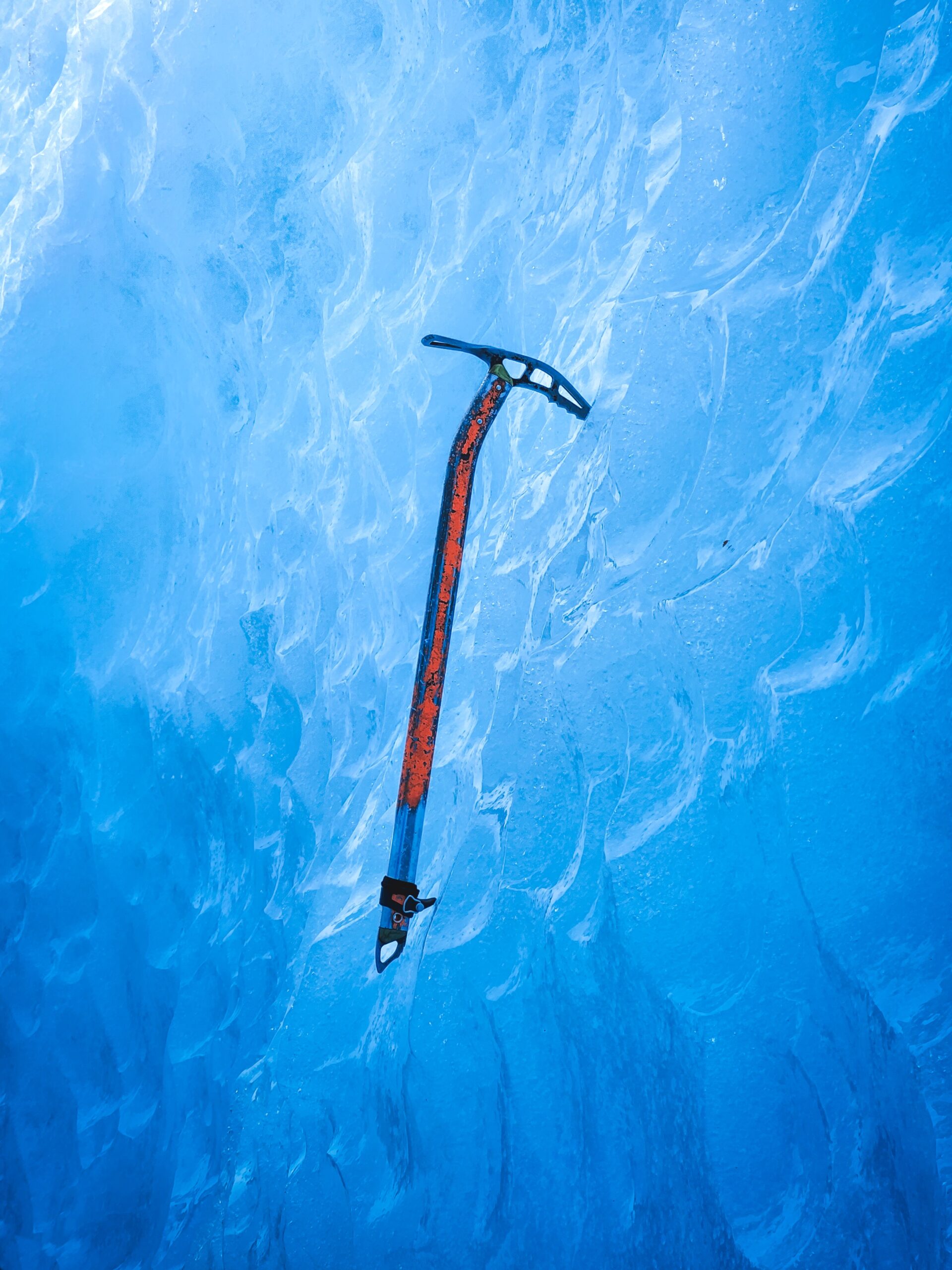
    So we throw words out, against the wind that’s blowing where we stand. We throw an ice axe into the ice cliff to hold our place while we fall down the rope. We try to set a marker: this is my best, this is the best of me, this is the best thing I’ve ever had, this is what I want, this is ground I need to peg to. We hope that we have chosen well, that the axe holds, that someone is on the other end of the line. We do our best to avoid choosing hastily, cheaply, unwisely. Then we jump into the abyss. There are actually abysses on each side: the abyss of the unknowns of being together, and the abyss of being apart. It’s easier to let someone wiser than us help choose which abyss better suits the moment. At a moment like that, one doesn’t see anything other than drastic options, but is held by the idea of walking with a light within / walking into the sun. So it doesn’t even look like an abyss.

    Or is it a moment of wanting to choose our pain when confronted with pain we didn’t choose. If I have to have pain, I want it to be the pain of my own relationship, of something I can actually fix, of something I have some part of control over, rather than pain I can’t choose and can’t control. If I choose pain, I choose my own romantic pain, not my parents’. If this is a pain which will change my life, then I will choose how it goes. And I will open myself to all it entails. And I will take my vulnerability there rather than backwards into my parents’ relationship. And I will fucking fix it. I will fix it myself. I will cause the breach, then I will fix it. Because that is how I will show that I am not someone who cheats, who shies away, who has an affair, I will show that I’m not like my dad, I won’t walk out, I am a show-up person. And I’m not like my mom either, I won’t crumple up and give up. I will be worthy and can even out the playing field with my own actualization. I will have integrity. I will take responsibility.

    And then we are reasonable. Ok, I have my internal drama but there’s someone else out there involved now. What can actually be expected. What is reasonable. I move my deep trust to the top shelf, ignore any other lower desires that were waking up for the time being. Professional. That’s it. That’s reasonable to expect, that’s where I’ll put all my trust. I can absolutely trust professionally. We don’t have to get to personal. Honestly the thought is overwhelming. What would she want, could I even make her happy. And ew, bodies. Scary, but what would it be like. Nevermind. Cuddle. No not even that, nevermind. I’ll just hang out here in the shadow of this rock of professionalism, where I am safe. I’ll curl up here, recover, go forwards. Here is where it’s safe to be.

    I plot my return. I need to become worthy of what I have said. Re-hide the hidden thing by holding it between us in the folds of striving. Let it fall back to the bottom of the lake, the hidden anchor. Be responsible. Have to stand up for it, own it, show up for it. Can’t just throw words like that out there and leave it there. Must have integrity. Words matter. My belief in words, in language became shaken in the intervening time. But far off, the idea of returning as worthy beckoned. Climb down the canyon, climb up the canyon into new words, new language, stand on solid ground, show up, reach parity by building my skills and standing. The task was clear.

    A personal mythology takes hold.

    Survival: spread your weight out on the icy lake to avoid falling through. Find others to support you so you don’t fall through the cracks. I spread my weight out on the ice, across people, and tried to creep forward back to safety.

    And then: crash. After all that time, I discovered that throwing the thing, securing the ice axe, having something to return to, was all a failure. A total, abject failure. And even worse, it had been taken wrong. So fucking misunderstood. As painful as an axe splitting me in half. And even worse than that, all of the gifts it had seemed to confer were actually deligitimized, gold turned to ashes, not admitted. All of the glowing things had only ever been in my imagination. And me, demonized. Everyone else was on a different channel, different discourse, and I was doing it all wrong. My tender, vulnerable parts, turned into weakness and game for attack.

    And that very precious thing, trust, had been destroyed at home, at home, and also at home. At every home.

    At some point, I probably had to come out of that personal mythology. I had to uncurl, face life differently. If that hadn’t gotten me, something else might well have. The stars are still so tantalizing. It’s still so easy to imagine constellations of how it was supposed to shape up. Out there, up there. And during the day there’s just a lot of uneven ground to navigate. And so I do that.


  • the brain as it is

    the brain as it is

    Sometimes one rolls all the way back down the mountain in a snowball of old junk, into old realities which block out the new and sabotage hopes of renewed peace.

    What I’ve had to acknowledge is that through some of my experiences, my brain changed and I have to be continually mindful to manage it well. Otherwise when my energy and/or inhibitions are low or stress is high I cannot regulate it. I simply can’t access that space where one steps back and notices one’s responses to whatever streams into consciousness like it’s a film. Sometimes I still need to find new tools. While others might be able to tolerate high-stress situations or an influx of chemicals, hormonal or other, without issue, I’ve learned that I have to be more careful and make sure to have things that keep me tethered to the here and now in order to avoid having everything feel unregulated, unfiltered, out of control. I have to avoid anything which could make it worse. I have to stop searching for answers which aren’t available or trying to imagine ways to fill in the gaps between disparate events I haven’t understood on my own.

    There was a time when I was just numb and for both internal and external survival reasons couldn’t respond to anything emotionally as it happened, but this just meant that those responses became eruptively protracted later on. There was one summer after some events where I was just in a big void of understanding what had happened or support and just sort of sank emotionally. It’s been terrifying to think of that happening again as I’ve branched into my new living situation, and even have a learning opportunity which is totally different from yet still somehow echoes a learning opportunity I had that summer, but because of some overwhelm hadn’t been totally able to take advantage of. Although I know that my course of study now isn’t nearly as challenging, I’m still absolutely terrified of failing or letting the people who helped me get the opportunity down.

    This has been hard because at some core level it conflicts with my survival myths, that I should be able to manage or gladiate anything, that I’m in control, that I’m low-maintenance and don’t need to demand a lot from others. That I’m not someone who could become too scared to cry, that I could not be immobilized by shock. That I should be able to wrap my head around and puzzle through anything. That I can find the answer. It can be hard to get any distance in the sense of temporality, to realize that at this point I’m better resourced and better connected than I was before, that I have more tools, that I’m less isolated, that my human experiences are just part of the experience of being human, and that something about that is sort of beautiful.

    There’s a fine line between learning about how an altered brain and psyche function and having this information lead to despair or hopelessness. But the other thing I’ve learned is that not acknowledging what’s going on just leads to longer term issues. It’s really unsettling to find that one’s rational mind is not always in the driver’s seat. I just have to try to have faith in neuroplasticity to be able to restore some of what was lost with the proper approach and support.

    One example has been my ability to concentrate. I used to be able to sustain long hours of very deep focus and a sense of connectedness to life without much effort, but during times of upset this changed. I was trying to learn a challenging language and to turn out long papers and was having such a hard time sustaining any focus, which only led to more frustration. One well-meaning professor once told me after some big events that she noticed that I didn’t seem to be able to focus. Instead of saying yes, I have not been able to concentrate and am feeling totally overwhelmed, even violated, and do not feel I can escape, I just felt that it was another way I was failing and tried to become more buttoned up and streamlined and commit myself to the charade that there was nothing wrong, that the ground was solid after all. I had wanted so badly to show that I could endure and handle it, that I was worthy of support. It was sort of like trying to walk or even run on a broken limb and enormously frustrating. In retrospect, I really ought to have taken a little time out (although for many reasons this seemed totally impractical if not impossible at the time) to regroup myself, to have pulled myself away from circumstances which only made things worse. But there still seemed to be shells in the shell game to turn over, maybe I would find what I needed if only I guessed the right combination of words, cracked the code, found the underlying logic. Sometimes the answer is not in the problem after all. But scary to confront that void. All of this has meant that it sometimes just takes me longer to get through my work or a book or to put myself back into the driver’s seat, and to remember that it’s always worth trying to get back up again.

  • Mount St. Helens

    Mount St. Helens

    Last week I went to see the Mount St. Helens exhibit at the Portland Art Museum during the typically – but that evening especially sparsely – attended Friday evening open hours. Just afterwards, the museum closed for at least a month but now probably two in order to help flatten the curve. Because this means that many won’t be able to see the exhibit, I’m documenting my visit.

    Apologies for some image misalignments or strange angles during a time of social distancing when I avoided getting too close to other visitors.

    One notable feature of the exhibit was that it included many more women artists than I might have expected. I had a hard time finding much more information out about them later, which attests to the strenuous curatorial work by the exhibit organizers.

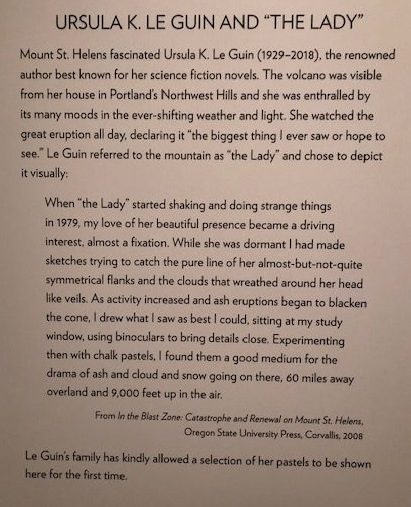
    Now we enter the galleries. All plaques can be found online here – nobody needs to try to read the text on my photos of the plaques. My selections just scratch the surface of the exhibit, but capture some of the pieces I found most compelling. Most pieces, unless otherwise noted, are titled “Mount St. Helens

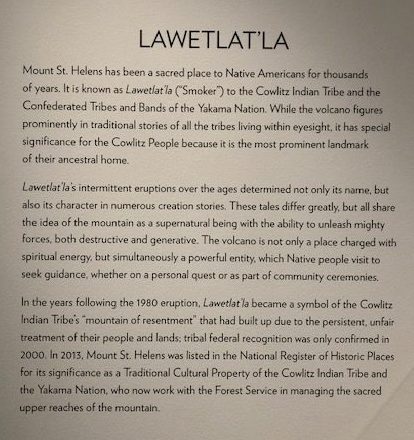
    Lawetlat’la

    Named by the Cowlitz and translating as “Smoker”, the volcano played a central role in Cowlitz and Yakima Nation tribal culture.

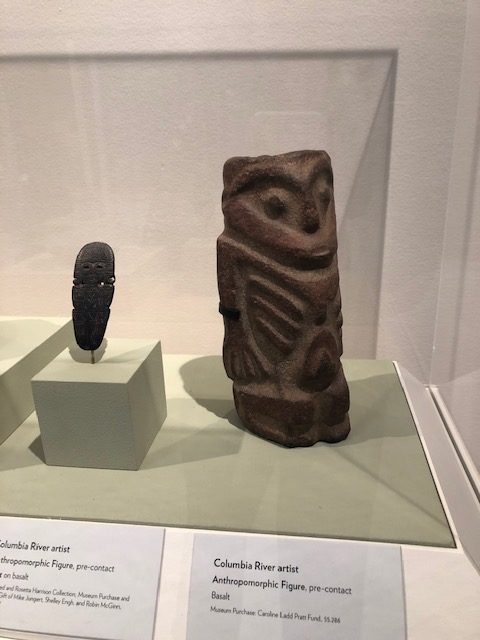
    Anthropomorphic basalt figures from the region.

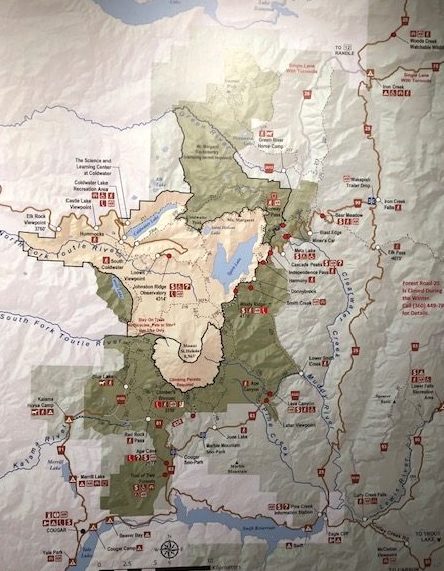
    The next room featured a present-day National Park map, a “seismic spider” used to measure seismic events, and video reels about the current state of the volcano.

    Leading into the exhibit were a series of depictions by contemporary local artist Lucinda Parker.

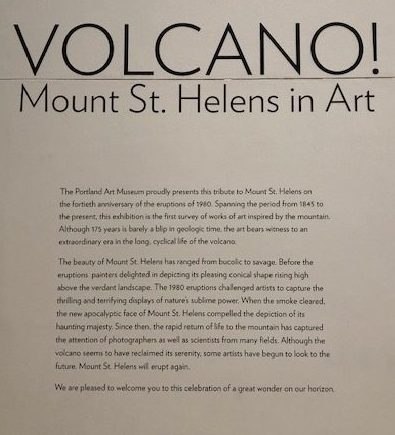
    Another welcoming intro to the shape of the exhibit which commemorates 2020 as the 40th anniversary of the 1980 eruption. The exhibit spans the time from 1845 to the present, as it evolved in art from a “pleasing conical shape” to the “Thrilling and terrifying displays of nature’s sublime power” to an “apocalyptic face” compelling depiction of its “haunting majesty” and the present-day return to life and “serenity.”

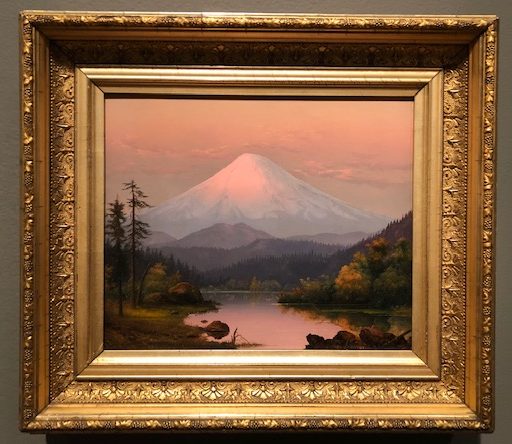
    The exhibit now begins with series of pre-eruption paintings.

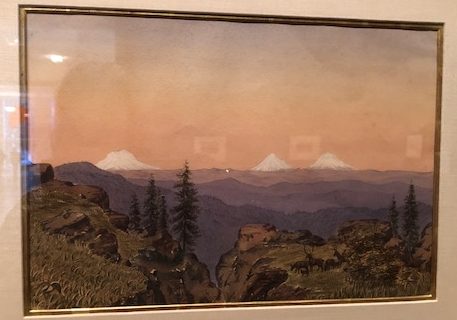
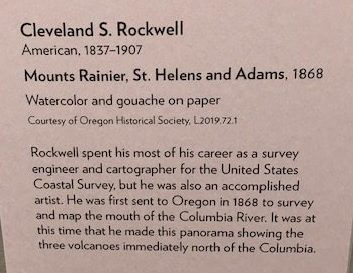
    Mounts Rainier, St Helens and Adams by Cleveland Rockwell.

    Mount St Helens by Grace Russell Fountain, 1980.

    The lower right image of a pleasing conical shape was painted by Grace Russell Fountain in 1980.

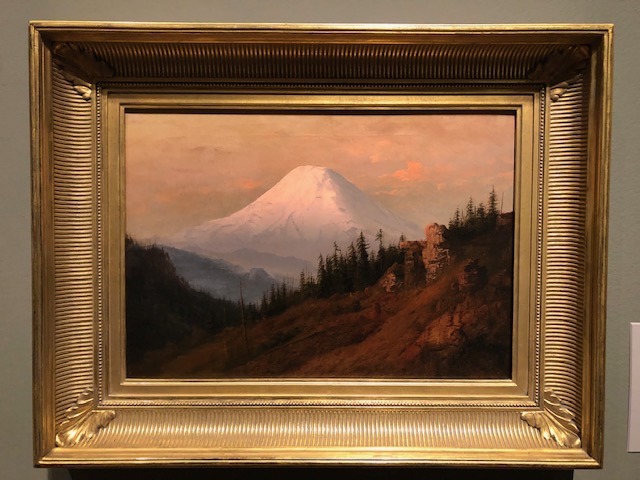
    It was featured alongside one by her teacher, William Samuel Parrott:

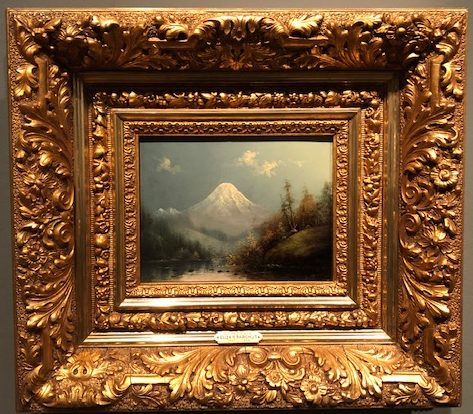
    which was flanked on the other side by one by his other student, Eliza Barchus:

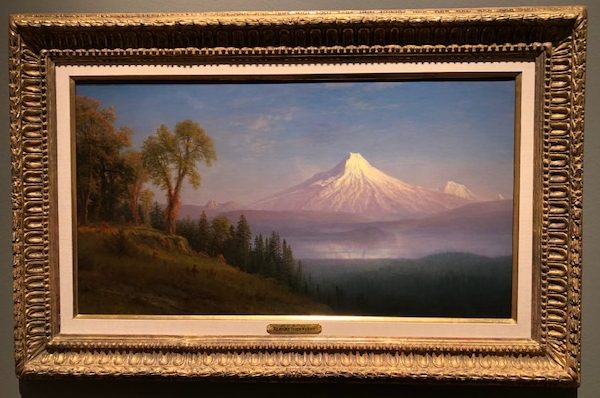
    Albert Bierstadt – Mount St. Helens, Columbia River, Oregon, ca. 1889 – the plaque notes that the trees in the foreground are autumnal deciduous, indicating the completion of the painting over a long period of time, spanning different seasons.

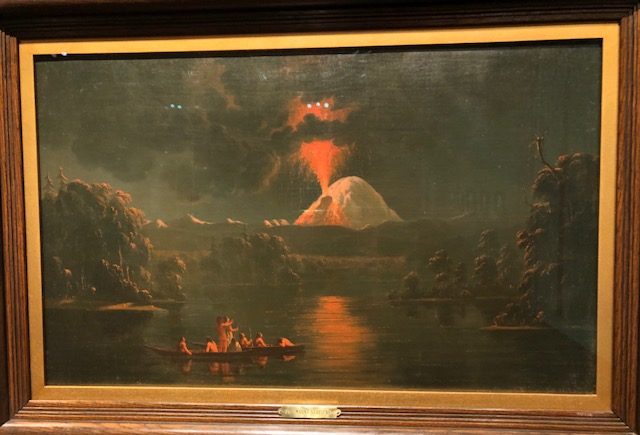
    One of the most compelling to me was the nocturnal portrait by Paul Kane between 1869-1856, which was painted in the European tradition of depicting Mount Vesuvius at night. Apparently this is the most famous depiction of Mount St. Helens completed before 1980.

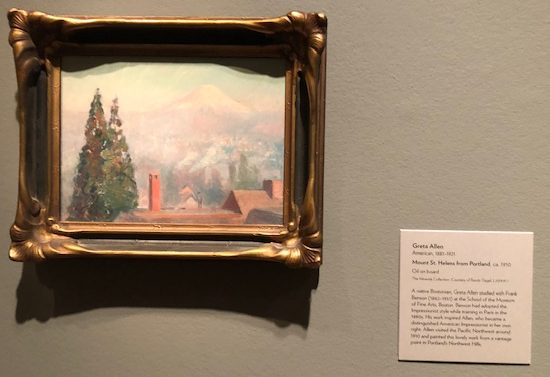
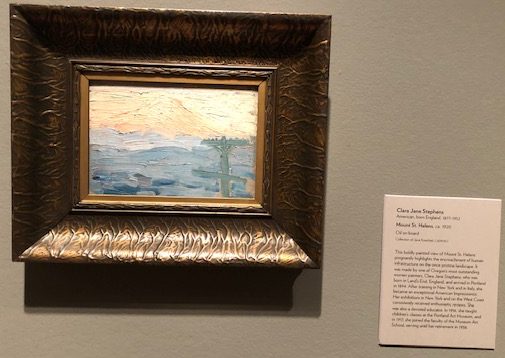
    Impressionists like Greta Allen and Clara Jane Stephens were also inspired by the volcano.

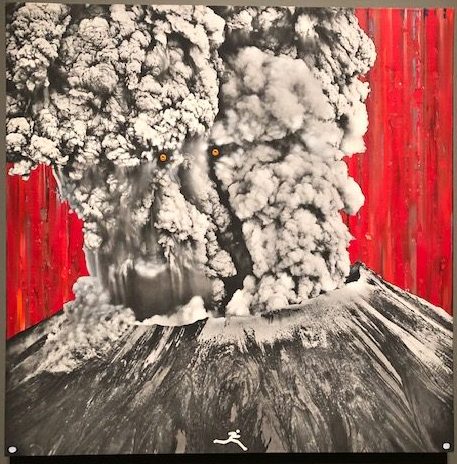
    We all know what happened next….. During the eruption, the top 1,300 feet of the volcano collapsed and 57 people in the area were killed. Most of this next section features work by eyewitnesses.

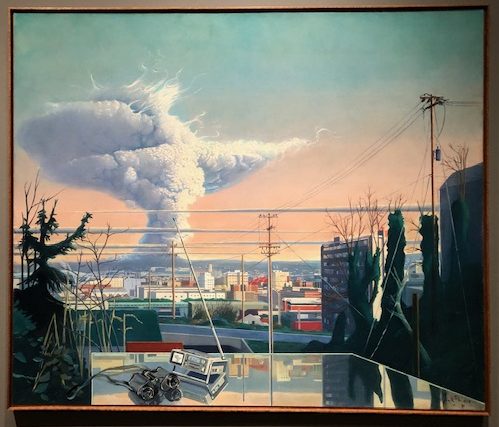
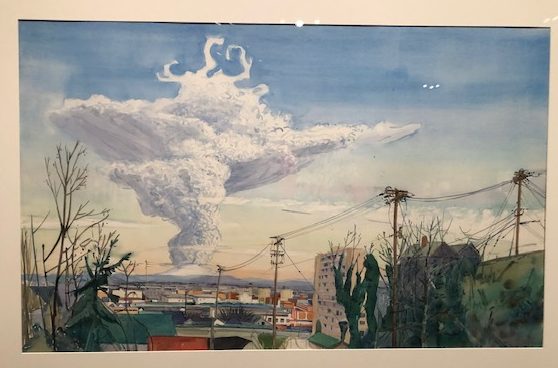
    Henk Pander‘s Eruption of Mount St. Helens from Cable Street to the right, and another below. That tenticular ash cloud is quite something.

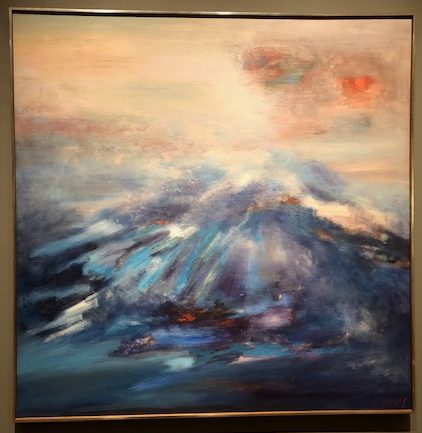
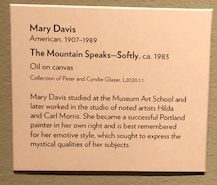
    The Mountain Speaks — Softly by Mary Davis on right. This piece was huge and enveloped the gaze right into it.

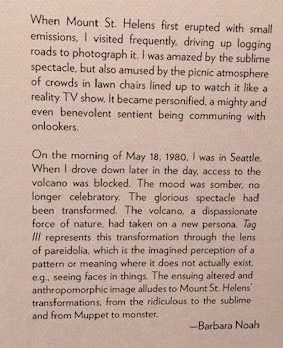
    Ok this one, Tag III by Barbara Noah, was one of my very favorites, capturing the transformation “from the ridiculous to the sublime, from Muppet to monster.” Check out those eyes.

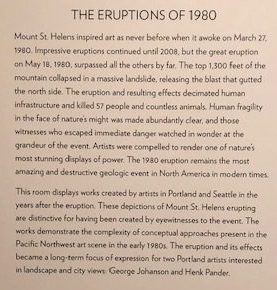
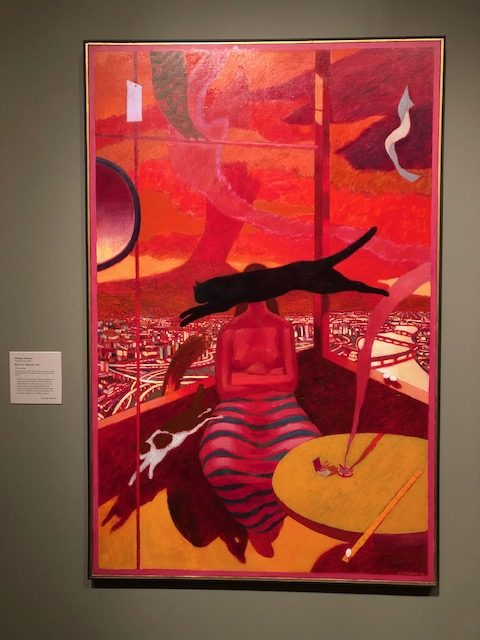
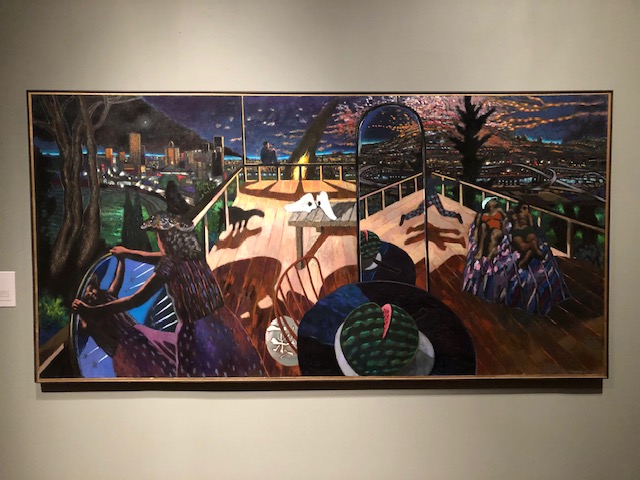
    George Johansen, another contemporary artist, plays with the exotic and the many meanings the volcano can take, as in Black Cat – Mountain on the left, and Mirrored Deck, below. The panting below shows a deck party where St Helens becomes a part of the festivities.

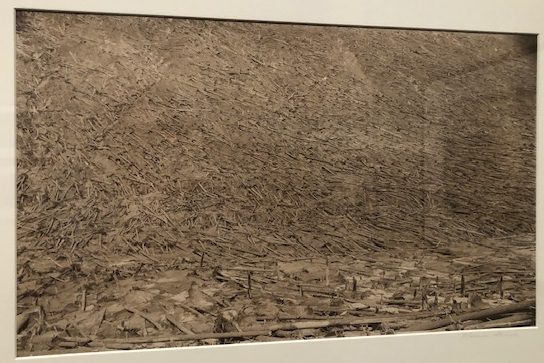
    This gallery section was followed by a room of photographs, mostly black and white, which depicted the devastation. My images did not come out well, partially because of the glare and also it’s just weird to take photographs of photographs. So I’m not going to show those, but the official Exhibit page features a couple of them.

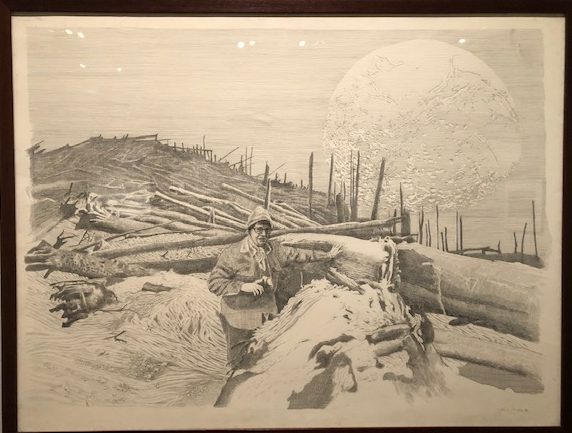
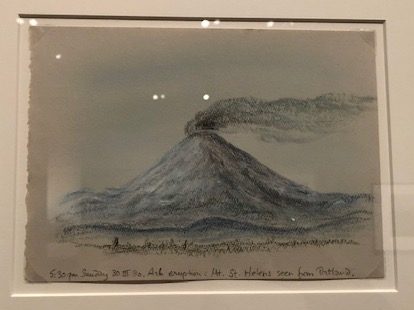
    In an alcove off of the photographs I discovered another favorite area: Ursula K. Le Guin’s pastel drawings of Mount St. Helens below and an image of her during a junket into the red zone at left by her friend Henk Pander, who accompanied her on this trip and whose work was profiled earlier.

    For more comprehensive info on Le Guin’s work in the exhibit and other art see this article in the Oregonian.

    ….. back into the room of photographs and objects …..

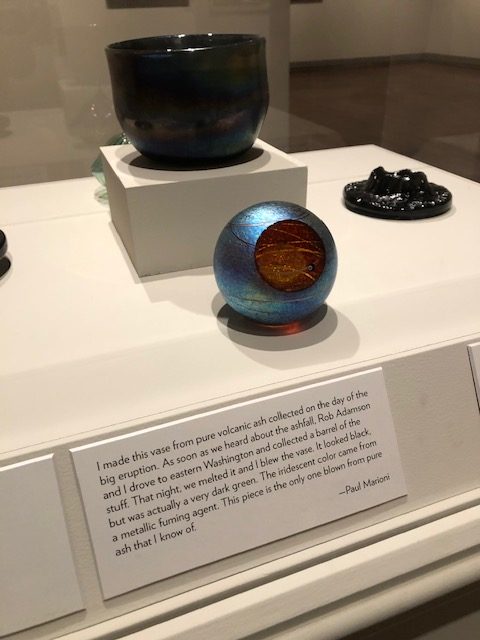
    Glass artists blew ornaments and even entire bowls incorporating the ashes from the eruption.

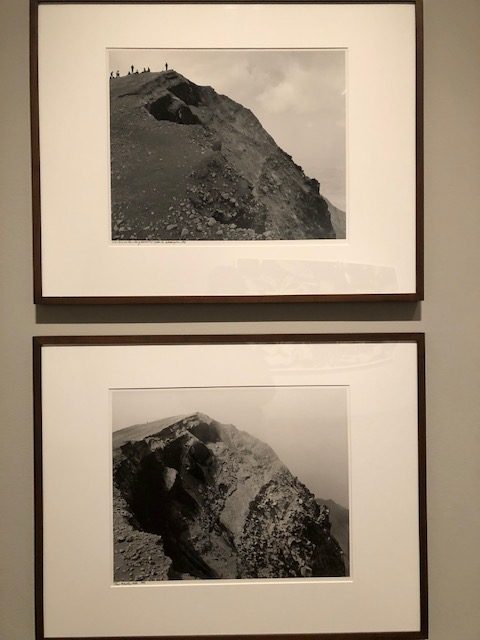
    the pure devastation. ok, just a few photos of photos.

    A part of the unstable rim photographed 10 minutes apart.

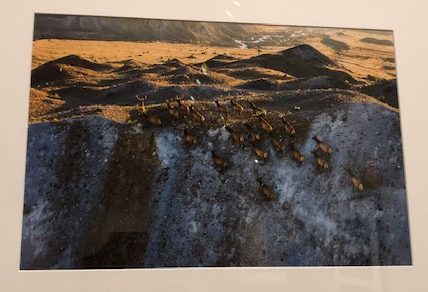
    Elk ascending the unstable rim.

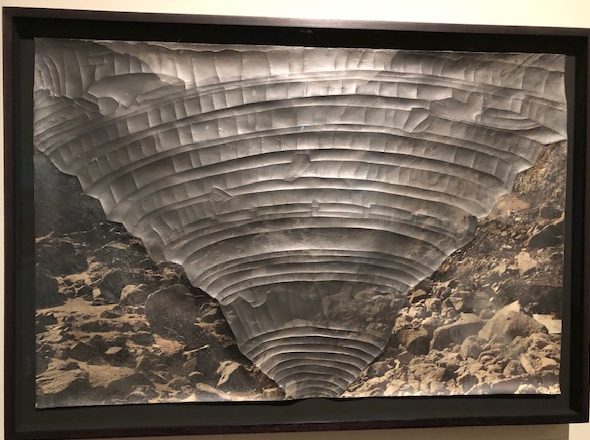
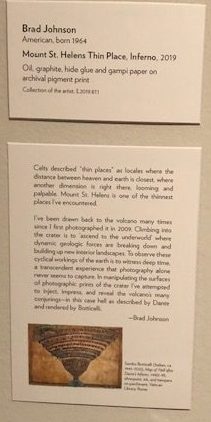
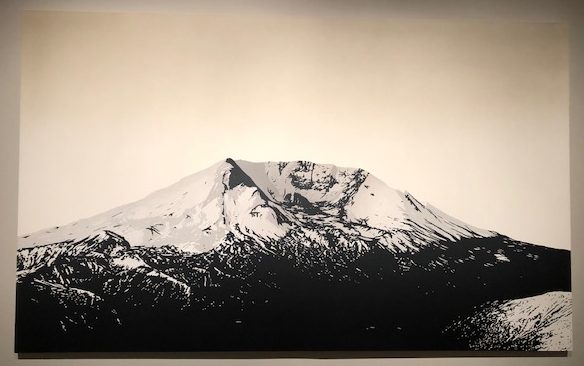
    Brad Johnson’s Mount St. Helens Thin Place, Inferno of 2019 — this was another that really captured me. The volcano as a Thin Place, where beings can transit to or from the underworld, also in the tradition of Dante/Botticelli. This piece was made with hide glue and gampi paper on an archival print.


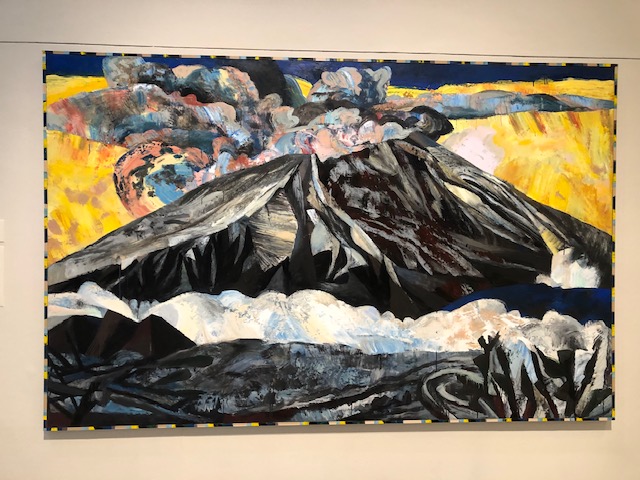
    The exhibit was rounded out by this enormous piece by Cameron Martin. Remission, 2006. Acrylic on canvas. 

    This final piece depicts the uneasy serenity of the volcano on our horizon now that we know what it can do. My photo doesn’t show it, but inside of the crater where the cone grows again the artist did a wonderful job of showing something seething there.


    I was 2 years old when the volcano erupted so have no personal memory of this event, though of course I grew up hearing about it. An affinity with the volcano, yes. Maybe at some point I’ll add images from backpacking trips through the moonscape of the MSH dead zone on the Plains of Abraham or the incredible vistas afforded by backpacking in the adjoining Mount Margaret Wilderness.